
- Power: England
- Group: Northern openings
- When: Fall 1901 onwards
- Target SCs: Denmark, Kiel
- Aggressive towards: Germany
- Extension of: Jorvik Opening
I don’t usually like the way the word ‘gambit’ is used in openings. It’s borrowed from Chess and involves a risky move. Often, in Diplomacy terminology, it’s not used in this way, the single exception being the Balkan Gambit, a Turkish opening in which Turkey doesn’t take Bulgaria in 1901.
With this E/R opening, though, this is very definitely a gambit! The one SC England can guarantee in 1901 is Norway. Here, England gives Norway to Russia in favour of getting a better position against Germany. However, to achieve this, you need France to work with you, too.
Here are the moves:
Spring 1901
- England: F Edi-NWG, F Lon-NTH, A Lpl-Yor
- Russia: A Mos-Stp, F Stp(sc)-GOB
- Germany: F Kie-Den, A Ber-Kie, A Mun-Bur/Ruh
- France: A Par-Pic, A Mar-Bur, F Bre-MAO
Fall 1901
- England: F NWG-NTH, F NTH-Den, A Yor H
- Russia: A Stp-Nwy, F GOB-BAL
- Germany: F Den-Swe, A Kie-Hol, A Mun-Ruh or A Ruh-Mun/Bel
- France: A Pic-Bel, A Bur-Mun or Mar-Spa, F MAO-Spa(sc)/Por
England captures Denmark. Russia gains Norway, Germany gets Sweden and Holland. France gains Spain. and probably Belgium. So who builds what?
Winter 1901
- England: F(Lon)
- Russia: A(Mos), A(Stp)
- Germany: A(Ber/Mun), F(Kie)
- France: A(Par), either A(Bre) or A/F(Mar)
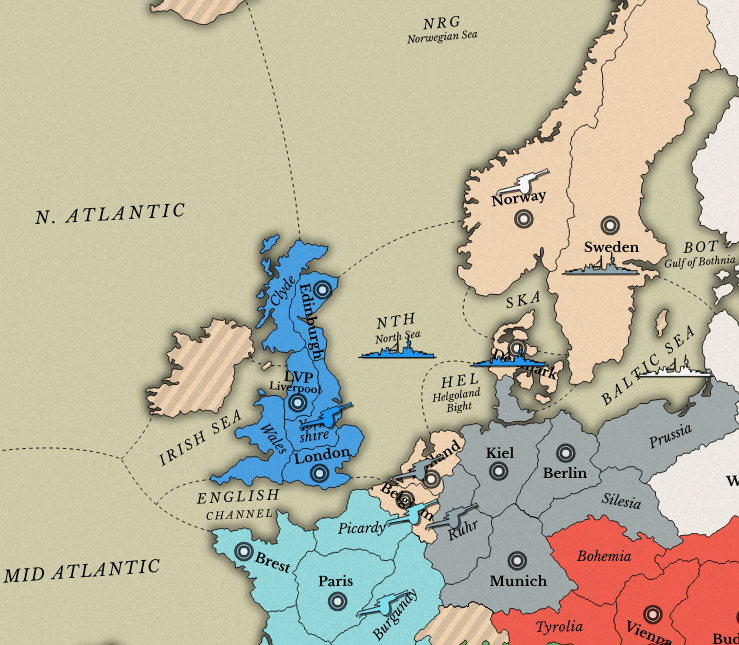
Which gives this position:

Here, Germany decided to build A(Ber) rather than A(Mun). It really doesn’t matter too much. They have to defend both: Munich from France or Berlin from Russia. France built F(Mar), deciding they had enough armies to go after Germany and they wanted a fleet to move into the Mediterranean.
The decision England and Russia have to make now is where to pressure Germany. All of Germany’s home SCs are under threat: F Den-Kie, F BAL-Ber, A Bur-Mun. Holland is under threat from an E/F combination, and Sweden is under threat from a joint E/R attack.
Given that Germany can cover Munich and Berlin with A Ber-Mun, if France orders A Bur-Mun, Germany has to figure that Russia isn’t going to try for F BAL-Ber. However, Russia has A(War): where is that going? Silesia? Prussia? Russia could use F BAL S War-Pru and succeed. However, Russia would be better to order A Nwy S BAL-Swe as something that can’t fail; maybe, then, F Kie S Swe-Den? England could defend Denmark with their North Sea fleet… but having built F(Lon) they’re surely aiming to move F(NTH). Again, though, where? Holland, with support from Belgium? More likely, F NTH-HEL.
Then again, Russia has A(Stp). They might try F BAL S Nwy-Swe, A Stp-Nwy. But A Stp-Fin gives Russia Sweden in Fall 1902… or A Stp-Lvn might provide them a chance to conovy that army to Sweden/Denmark/Kiel/Berlin in 1902!
What do you, as England, want to do? Ultimately you’re aiming to get into Kiel. Russia can take Sweden in F02 anyway, that’s why they built A(Stp). Sweden isn’t the priority. So what you want are the following orders:
Spring 1902
- England: F Den-Kie, F NTH-SKA, F Lon-NTH, A Yor H
- Russia: A Nwy-Swe, A Stp-Fin, F BAL S Den-Kie, A War-Sil/Pru
- Germany: F Swe-Den, F Kie S Swe-Den, A Ber-Mun, A Ruh S Hol H, A Hol S Ruh H
- France: A Par-Bur, A Bel-Hol, A Bur-Ruh
Assuming this all works, Germany has to retreat from Kiel to Berlin and the situation is:

Problems Galore
It is possible that this can work, and from here there are all sorts of possibilities: Holland, Denmark and Berlin can all fall to the allies, in a number of combinations. For England, the best chances are to take Holland and Kiel, if France and Russia are happy to help this. As France has gained Portugal or Spain this time, and Russia has got into Sweden (and possibly Denmark), there shouldn’t be any reason why they won’t help England get both.
But there are any number of problems here. First, it really needs a Triple Entente alliance (E/F/R) if it is to work well. Without France fully on board, England must encourage France to attack Germany and, as this gets held up once Belgium is French, it could be more difficult to keep France on board. It looks very much as if you and Russia are going to get more from Germany than they are!
Second, once you get into 1902, it becomes a guessing game. Germany is clearly under pressure and can’t protect everything at once, but all it takes is for them to guess correctly and things can fall apart. And that continues even if you get into the position above. Given that they’ll not be getting a lot of help from anyone in the West, they’ll be working hard to have Russia attacked in the East.
Third, this is all stymied if Germany risks orders A Kie-Den in Fall 1901. This is the low percentage move – they’re gambling on F Den-Swe succeeding and taking Sweden and Denmark rather than Denmark/Sweden and Holland. If they order A Kie-Den, you’re bounced from Denmark and left with no build. As I say, though, this is less likely than A Kie-Hol.
The other issue with these moves is the English army, which is left twiddling its thumbs in Yorkshire. You could try to convoy it to Denmark in F01 but, frankly, an army in Denmark is only useful if you are sure you’re going to succeed with A Den-Kie in 1902. It’s a rare situation indeed when an army is better than a fleet in Denmark.
An alternative opening, which sees England move to Denmark in F01, is the Jutland Opening. This is an extension of Ouse Opening and is similar in that you’re still offering Norway to Russia and trying for Denmark, but has a chance of getting into Belgium as another SC option if all else fails.
POSTS IN THIS SERIES (Links marked with [X] indicate extensions to the initial openings.)
- England’s Opening Moves – Introduction
- Churchill Opening
- Jorvik Opening
- Leith Opening
- Ouse Opening
- Severn Opening
- Grampian Opening
- Pennine Opening
- Snowdonia Opening
- Western Opening
- Yorkshire Pudding Opening
- The Levy Opening [X]
- The Arkangel Opening [X]
- The Norwegian Gambit [X]


 THE DIPLOMATICON
Leave a comment