
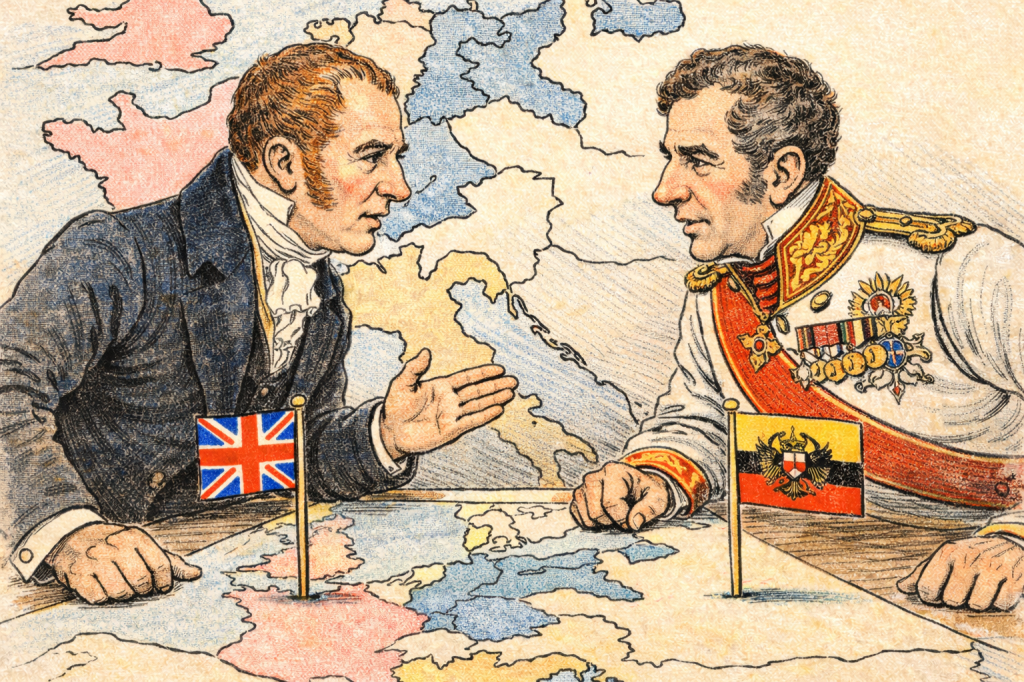
| Powers | England & Austria-Hungary |
| Game stage | Mid-game |
| Primary target | ??? |
| Alternative names | Anglo-Austrian |
There really isn’t very much to say about this alliance. What on earth are you doing forming an alliance with the other player in this scenario in the Early Game? How – HOW! – do you intend to help each other???
This is a potential Mid-game – or even Endgame – alliance. In the Early Game, there is nothing for the two players to do except, perhaps, agree to share info.
I offer this a lot to non-neighbours, regardless of which power I’m playing. There’s a reason for this: I don’t want to be coming to a part of the game when I need the other player’s help and just starting to build a relationship.
Unfortunately, not as many players as you’d think, given the game, seem to understand this. This might be because I play my Dip online, and there are more newbies there. It’s understandable, when you’re new, to think that communicating with someone elsewhere on the board is pointless.
Wtf is a Castlereagh?
A Castlereagh is a person, actually. The name is pronounced castle-ray. He was the British Foreign Secretary towards the end of the Napoleonic Wars, and had a huge part to play in the Congress of Vienna and creating the non-system known as the Congress System.

Castlereagh was a great believer in Constitutional Monarchy, the system of government in the UK at that time (and still, though much less monarchic, today). He wasn’t happy about the restoration of the Bourbon monarchy in France, as such, although he fought to make it a much less autocratic system than had existed before the Revolution. In this, he stood alone among the representatives of the major powers – the Austrian Empire, the Kingdom of Prussia, and the Russian Empire where all autocracies.
As a leading architect of the post-Napoleonic peace, along with his Austrian counterpart, Prince Metternich, Castlereagh managed to protect the newly reformed Kingdom of France by having buffer states put in place, rather than France losing land – on the Continent, at least. Britain took it’s pie from overseas territories! France reverted to just about its old boundaries, with the loss of some land on the Rhine which was handed over to Prussia. Thus, Europe was supposedly protected from an further expansionist France by building the United Netherlands (a territory of the Austrian Empire), the Germany Confederacy (replacing the Holy Roman Empire that had failed to stop French expansion) under the joint chair of Prussia and Austria, and Austria took land in northern Italy.
The Congress System, the governing of Europe under great power conferences, was created by Castlereagh and Metternich in an attempt to create a diplomatic balance of power. However, the UK never fully committed to this system, partly because Castlereagh committed suicide in 1822 and his successor, George Canning, distanced Britain from the autocratic policies of the three eastern states. Britain, a long-time enemy of France, found itself growing closer to the new, constitutional monarchy on the other side of the Channel.
I could have chosen ‘Metternich’ to name this alliance, of course. I didn’t simply because ‘Castlereagh’ is much more fun to say.
When does this alliance kick in?
So, when does the Castlereagh Alliance begin to make sense?
The thing is, it might not ever make sense! It relies on England and Austria surviving into the Mid-game, at least. This is something England can often do. Austria? Not so much.
Then it relies on England needing Austrian support to balance a third power. That might be Germany, Russia, France… well, depending on the circumstances, any of the other five.
The problem is that England is very much a maritime power, and an outer power. Austria is a land-based power, even sometimes winning with no Austrian fleet on the board. They’re also an inner power, which means they’re never free from some kind of pressure. The question is therefore often one of how the other player can actually help?
One example which some of you might find surprising is a common goal of containing or jointly attacking Germany.
As far as it exists at all, the most consistent alliance in the game is the Austro-German ‘Dual Alliance’. I say “as far as it exists”, though, because it often doesn’t exist at all!

From the start of the game, these two players have each other’s back. Germany won’t attack Austria because Germany’s problems are all in the other directions. Likewise, Austria hasn’t got the luxury of attacking north. This makes the ‘alliance’ more of a non-aggression pact (NAP) or, at most, a mutual defence pact (MDP) if they agree to defend each other from other powers, commonly Russia. It’s rare, in the Early Game, that they can actually work together (and even unusual for an MDP to actually mean anything!).
This Dual Alliance is, however, ‘known’; ie. (almost) everyone recognises why it exists at the start of the game, and a good proportion of players will carry it through as long as they can.
This is surprising in that they are actually competitors. I don’t just mean both players are competing to win the game, I mean that they are competing for the same areas of the board. Both are inner powers; both sit solidly on the Barren Zone*, both will often have to take ownership of one or two of the other’s home SCs to win.
Now, let’s look at the Mid-game, possibly later in this stage. England is doing OK, on a decent number of SCs. Germany is doing comparatively well, perhaps better. Austria has also got themselves into a fair position. England and Germany can’t work together to get at Austria, unless England is well into the Mediterranean sea spaces and able to challenge Austria in, say, Italy. Austria and Germany can’t work together against England, unless they can combine to strike England in France or Russia.
However, England and Austria make classic hammer and anvil, or pincer, combination against Germany. Here is when a Castlereagh alliance can come into its own, either to pull Germany back to some sort of parity, or to allow each player to make gains and their own progress. And the really good part? England is unlikely to need to get into central Europe, where Austria needs to make gains, so they’re unlikely to be directly competing.
Similarly, they could combine against a strong Russia (from the north and south), against a strong Turkey (north and west), Italy (England in the Med, Austria to the east) or France (Austria again in the east, England from the north).
Watch out for …
Neither player wants to act in a way to help the other player win… well, not usually. Both, therefore, need to watch carefully the number of SCs the other holds and the number of potential SCs they could hold.
It’s a nice alliance in that, in many circumstances, one player can simply withdraw their support without putting themselves under any direct threat from the other.
The key to making this alliance work is created in the Early Game, with early and consistent communication, as well as being prepared to overcome the preconceived necessity of the Austro-German alliance later in the game.
NOTES
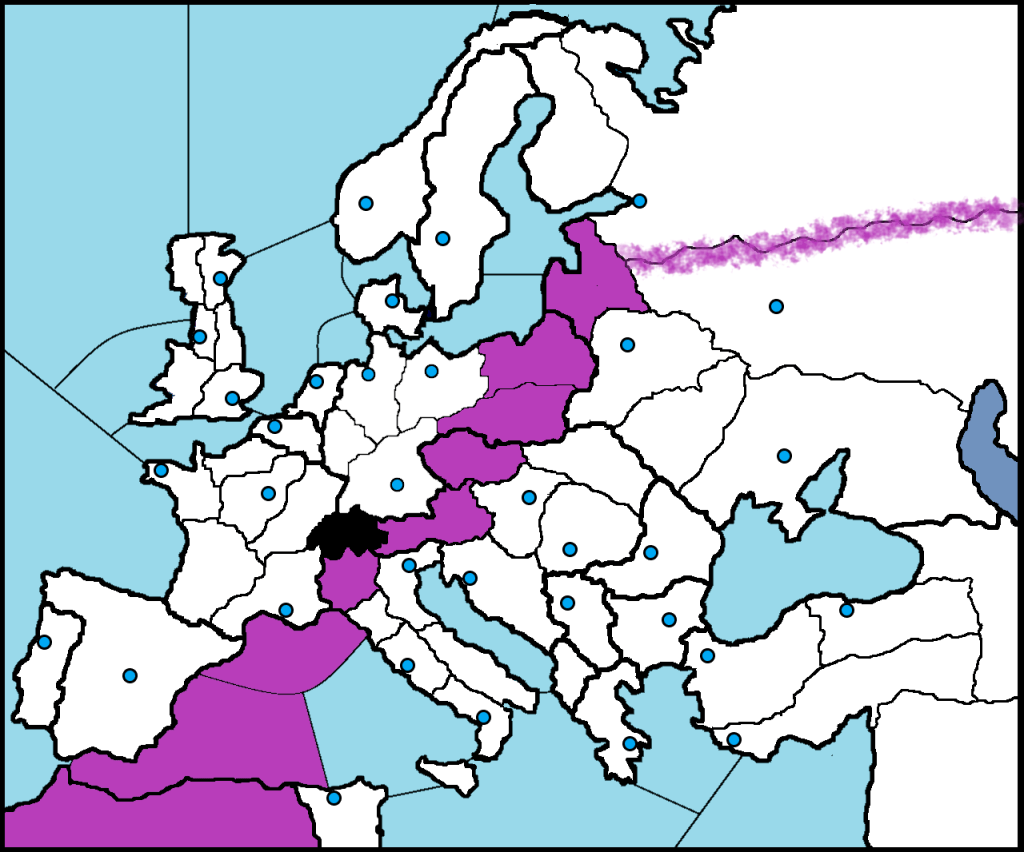
* Barren Zone: The line of non-SC spaces and sea spaces that separates the West from the East on the board.


 THE DIPLOMATICON
Leave a comment