
| Powers | England & Russia |
| Game stage | Early Game |
| Primary target | Germany |
| Alternative names | Anglo-Russian; Top of the World |
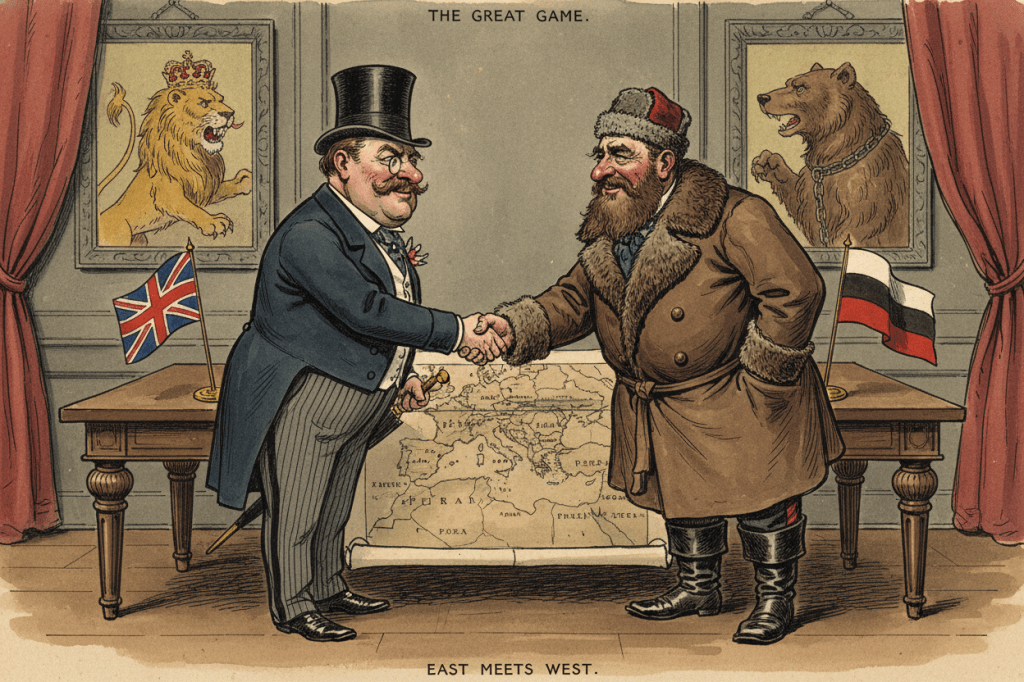
I’ve looked at all sorts of names for the E/R alliance. I’m not particularly a fan of the “Top of the World” alliance name, although it has some appeal.
“Lion and Bear” alliance is nice… although, if we’re using animal names, we get stuck with the two eagles of Germany and Austria.
So I did some research and, not that long before England and Russia found themselves on opposite sides in the Crimean War, they were allied – with France but let’s ignore that! – against the Ottoman Empire (Turkey in the game) at the Battle of Navarino, aiming to prevent Ottoman assaults on rebelling Greeks.
The E/R alliance, then, is one I named the “Navarino” alliance (and it’s a name I’m sticking with, now!).
Strengths and Weaknesses
Despite the fact that Russia is not always considered a Western power (given that it is solidly in the East, this isn’t surprising), St Petersburg, Russia’s northernmost SC, sites on the same side of the Barren Zone as England, France and Germany’s SCs.
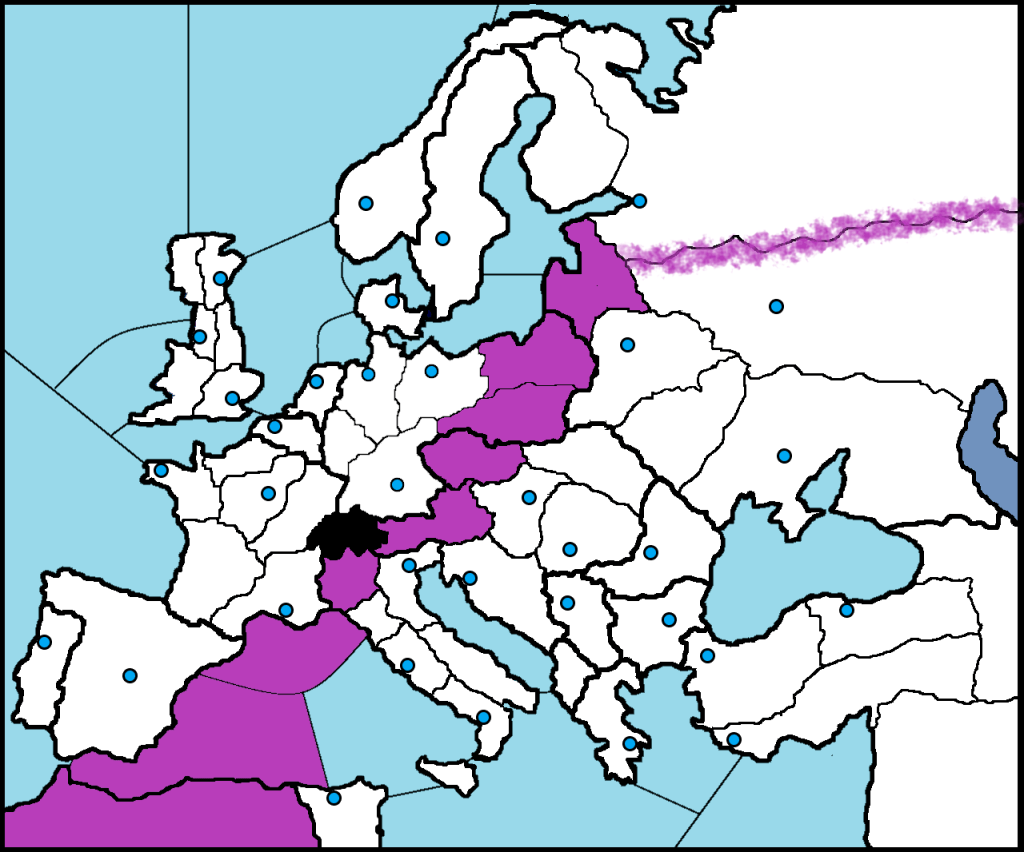
Perhaps it would be best to call the ‘West’ the ‘North’ as this would deal with this apparent confusion. However, the term Western powers has been used for some time now and it isn’t that simple to replace.
The E/R alliance is potentially the strongest one, certainly for England. The two aren’t immediate neighbours from the start and it isn’t until the end of 1901 that they might have units bordering each other. This gap, which is often considered a weakness in the alliance is, I believe, a strength. Before they come into contact, they have to agree what the situation will be when they become neighbours.
This, though, could well be one weakness: England wants Norway in 1901 in almost all cases, and this puts an English unit on the border of St Petersburg. Russia, on the other hand, may want to prevent England taking Norway if they can. A cautious Russia only need order A Mos-Stp in S01, and they have a unit that can be ordered to Norway, potentially bouncing with an English unit moving there.
This isn’t too difficult to overcome, though. If England will agree to land a fleet in Norway, rather than convoying an army there, Russia will be happier. Should England be less honourable than they pretend, a successful invasion of St Petersburg by a fleet is usually deemed much less useful than an army occupying the space.
On the other hand, while it is generally held that A(Stp) is much better than F(Stp) for England, there really isn’t that much different. Yes, A Stp-Mos is possible with the first, whereas F Stp-Mos is illegal. But, at this stage of the game, England shouldn’t really have any worries about possibly taking the SC with a fleet; if you’re going to take it, take it. Right now, it’s just an SC; later you can probably find a way to swap the fleet out for an army, if that’s needed.
But that’s not very friendly, and we’re talking about an alliance between the two! Taking St Petersburg isn’t going to help… in most cases – and the one case where it might be a useful thing to do is even more unlikely than the “Hey Bresto!” opening with France.
So, England agrees to take Norway with a fleet. They agree to support Russia into Sweden should the nefarious Germany bounce F BAL-Swe with F Den-Swe in F01. And, of course, Germany is the common neighbour and therefore the common enemy.
The Scandinavian Sweep
It’s never easy to attack Germany straight off for either power. Russia could order A War-Pru/Sil in S01, but that’s a tough prospect for a Russia that faces possible aggression from an Austro-Turkish alliance. England could order F NTH-SKA in F01, but that leaves the North Sea unoccupied and vulnerable.
However, one option is to lure Germany into Sweden, freeing-up Denmark for a strike from the North Sea. It’s risky, but if you’re in an E/R alliance, you’re got to take risks.
In S01, England orders: F Edi-NWG, F Lon-NTH and A Lpl-Yor, a standard opening. Russia orders: F Stp/sc-GOB and, if you’re going to do this properly, A Mos-Stp (yes, England, that is necessary). Germany sees this move, and buys England’s cry of Russian perfidy, as well as Russia’s promise to keep England out of Norway.
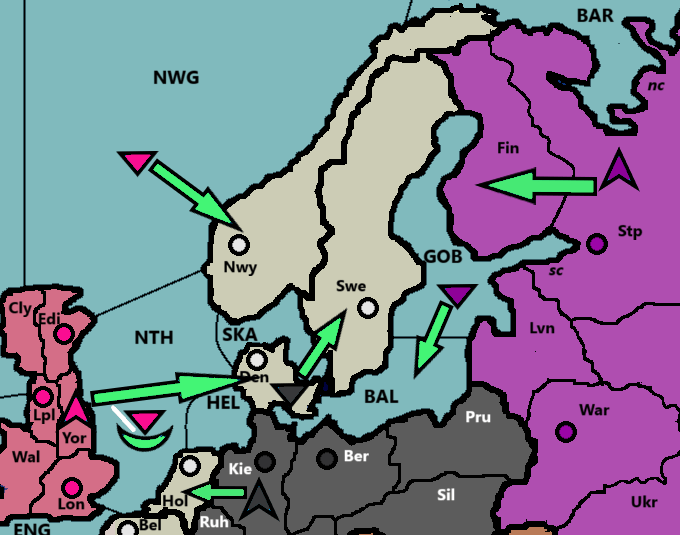
Germany then has no reason to not order F Den-Swe in F01, even if pretending to ally with Russia. Why? Well, if Russia is stopping England getting Norway, it shows England that Germany’s sympathetic and prepared to work with them. And, while it runs the risk of pissing off Russia, it what difference does that make? Even if they get something in the South – Rumania, probably – what are they going to do about it?
So, Germany orders F Den-Swe which succeeds. To Germany’s horror, though, Russia has moved F GOB-BAL and A Mos-Fin. They now have two units bordering Sweden. England, meanwhile, has not only succeeded with ordering F NWG-Nwy, but has also ordered F NTH C Yor-Den, which – in the playout above – has succeeded because Germany chose to order A Kie-Hol.
Why would Germany do that? Why not order A Kie-Den? Well, they’re expecting F Den-Swe to fail, and even if it doesn’t, with Sweden and Holland, they have two builds, and a new unit appears in Kiel. Meanwhile, we can’t see what’s happen around southern Germany. Are they stuck in Munich, having bounced in Burgundy with France? Have they moved A Mun-Ruh, intending to support England or France into Belgium, or bounce one there… or even to take Belgium? Either way, A Kie-Hol is the percentage call.
Not all is lost for Germany, even without considering the possible diplomatic efforts. However, let’s also consider a Russia who has gone all-out on working with England: where is A(War) now?
It is a brave Russia that will do this, but consider what happens if Russia ordered A War-Sil or even -Pru in S01. If Russia has played the Levy Opening – with A War-Sil – they have an army bordering Munich and Berlin. This completely destabilises Germany, meaning that even A Kie-Hol isn’t likely in F01 because they have to cover these two SCs. Of course, Russia is leaving themselves weak in the south but one way of achieving this is to ask both Austria and Turkey to let them take Rumania… and then they’ll concentrate in the north. Yes, if A/T work together, Russia has problems of their own, but we haven’t yet considered Italy, who will want to work with one of these two to attack the other; can Austria and Turkey put aside their usual mistrust to ally against Russia?
The outcome of this, if all goes well, is an England and Russia split of the Nordic region: England taking Denmark and Norway, Russia taking Sweden – and with a great chance of taking Berlin, too. What now of Germany?
Well, that depends on France. Pulling France into this alliance as the third wheel, forming the Triple Entente alliance, means Germany’s game is over. And why wouldn’t France do this? There’s really no reason to not expect an E/F alliance is England’s first choice, after all.
The View from London
The E/R alliance can all but guarantee the early fall of Germany, especially if Russia is fully on board. From there, it’s a matter of dealing with each partner’s own region of the board. England can move against France.
One issue with this is that, having allied to take down Germany, France may have been brought on board. Unless England has been able to cry off helping France attack Germany, using the need to throw units at Germany in the north, which may have slowed French expansion down, France is a more daunting prospect than otherwise.
Still, even if France, as part of the Triple Entente, has done well against Germany, and even as Russia will be turning their attention to the south, there will still be room to cooperate in the Mid-game – kicking France out of Munich, for instance. And Russia could well be in position to loan an army or two to push France back.
There is also the option, as always, of abandoning the Early Game Navarino Alliance. An preferential alliance with France could help both push further east… and England has probably the best chance, as Russia’s northernmost units will be facing an English onslaught without any other support.
The main concern is an F/R alliance at this point. While the two are at opposite sides of the board, they can sandwich England between them. Truly a Hammer and Anvil alliance!
The View from St Petersburg
[Yes, I do mean St Petersburg. Moscow became Russia’s capitol in 1918; it was St Petersburg before then.]
If Russia is holding on for dear life in the south, which they may be given their focus on the north to crush Germany, they have two choices.
They could maintain the Navarino Alliance, or at least make it a non-aggression pact (NAP). Units clearing out of Germany can head south, moving into Austria. And, if they can form a new alliance with Italy, they can make headway here.
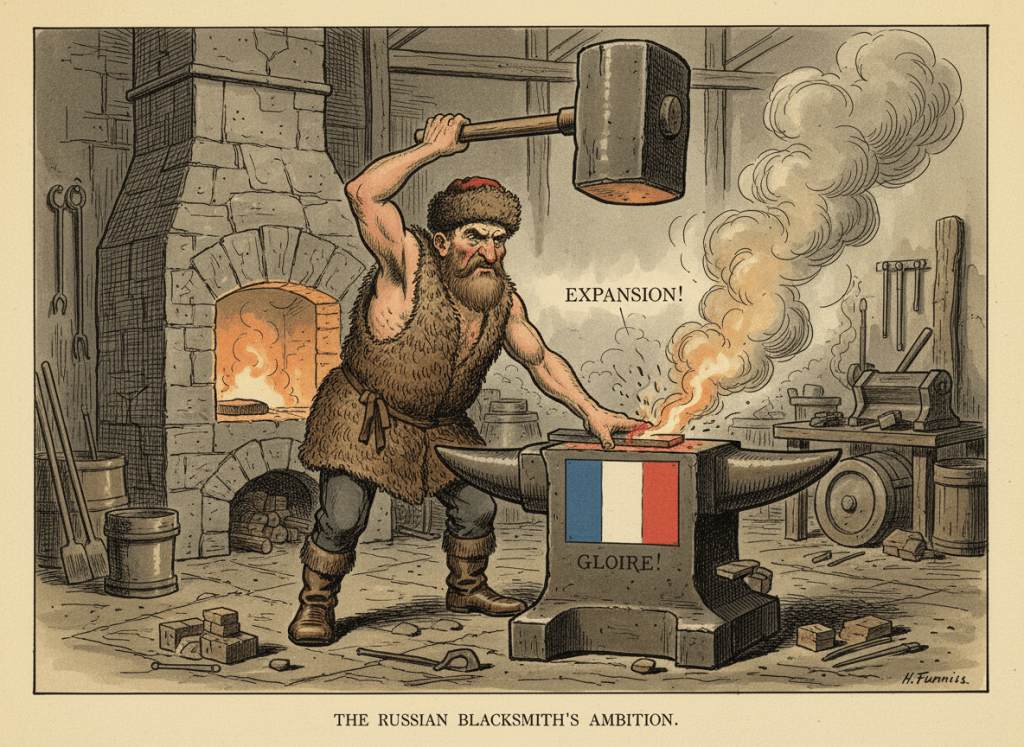
However, the south may be lost, so Russia’s best option then is to work with France. Units won against England can be built to help in the south, assuming they still have the ability to do this.
Russia’s concerns have both been mentioned above: an E/F alliance moving east against them, and an irreversible loss of ground in the south. Only diplomacy can save them.


 THE DIPLOMATICON
Leave a comment