
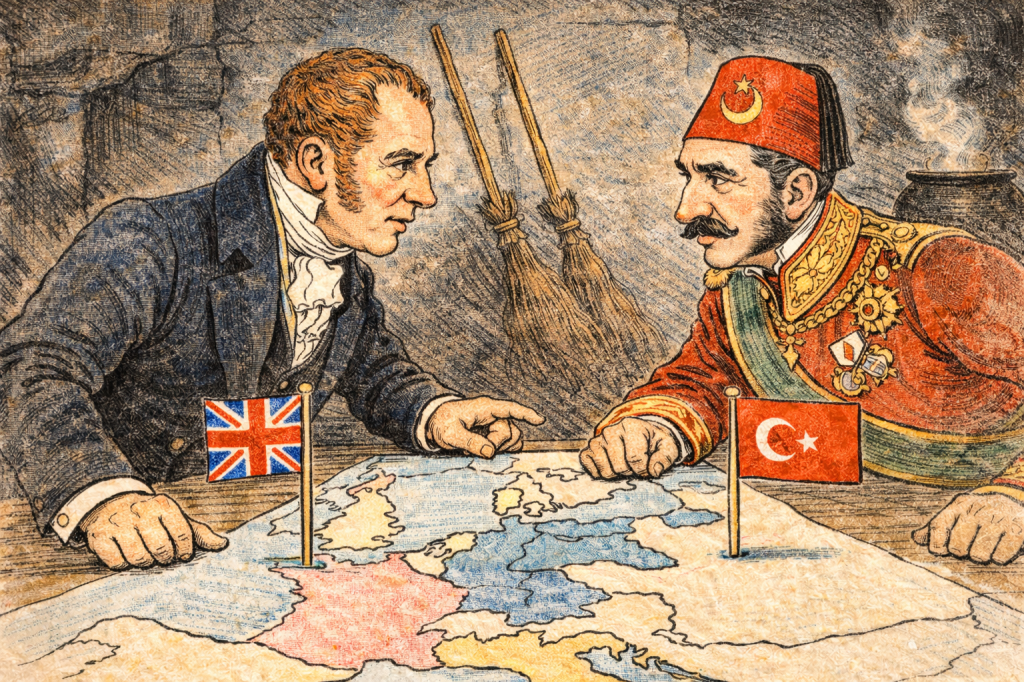
| Powers | England & Turkey |
| Game stage | Early Game; Mid-Game |
| Primary target | Russia |
| Alternative names | Anglo-Turkish |
England and Turkey are known, in Diplomacy, as the ‘Witches’, although not exactly wicked ones. This isn’t because they’re magic to play – neither power wins many games.
Witches, in fiction at least, are hard to kill. Of course, they only exist in fiction, although many women (and some men) have been called witches in the past as a way to use them as a scapegoat for all sorts of things: plagues, bad harvests, loss of livestock, etc. And, yes, I know there are people out there who swear by ‘magic’ and claim to be witches but, well, some people argue that the world is flat, so, yeah …
Leaving aside scapegoats and fantasists, England and Turkey are known as witches because they are notoriously hard to eliminate (kill) in Diplomacy. Both have strong defensive positions. So strong, in fact, that this doesn’t really help in them winning games.
In the absence, then, of any other name for the Anglo-Turkish alliance, I’ve called it the Broomstick Alliance. The one between two witches. Will it sweep the board?
A Rarity
This is a possible Early Game alliance, but one that rarely occurs. They are completely opposite each other on the board, England in the north-west, Turkey in the south-east. They can’t work together directly, and the only common enemy they have is Russia.
The other reason why the E/T alliance is rare is that it is usually better for either power to ally with Russia than against them. For England, the Anglo-Russian alliance is, surprisingly perhaps, potentially the most effective alliance in the north. For Turkey, the Russo-Turkish alliance is the infamously unstoppable ‘Juggernaut’. Given that both England and Turkey can often do well from an alliance with their common enemy, why would they ally against them?
Still, should England decide that they’re heading to St Petersburg and looking to defeat Russia, then having Turkey act aggressively against Russia is a clear advantage. And, of course, vice versa. The distraction of England attacking Russia in the north is that it means Russia will often divert units to this front, providing an advantage for Turkey in the south.
As England, what I find useful about communication with Turkey in the Early Game, which should include an offer of an alliance, is that you can share information and even plans with them. Turkey has little to gain from giving faulty advice, and will be happy find out what they can about the West. Again, the reverse is also true.
Caging the Bear
So, let’s move on to the Mid-game, when the Broomstick Alliance might actually have a prosperous impact for both.

Perhaps England has been working with Russia up to this point but now sees an advantage in attacking their ally. Perhaps it is Turkey who sees this chance – it is common for Russia to gain a lead in an R/T alliance. It could even be that there has been E/R/T alliance in play but England and Turkey decide that Russia is just that little bit too strong.
This is when the E/T alliance really comes into its own. Both powers will be neighbouring Russian units. If they can turn on Russia at the same time, then Russia will find themselves in a tough position, especially if they are left to face other units in the centre of the board, having expected support from their former allies. There is definitely something magical about English and Turkish armies meeting in Moscow!
But there’s more! England is likely to be fleet-strong. Turkey, although less clearly a maritime power, may well have built fleets to push through the Mediterranean while Russia focused on armies. This may provide the two witches to work together to take control of the Mediterranean spaces, too!
The View from London
Turkey is a long way away, and often finds it hard to fight their way out of the box the eastern powers can build around them. The only real advantage is when Turkey turns on Russia. Joining in as the other side of the pincers is always going to be profitable.
However, in attacking Russia, fleets only get so far. You’ll need to get armies into northern Russia, or else you’ll face the prospect of jubilant Turkish armies taking Sevastopol, Moscow and Warsaw. As you may well need to take at least one from the two landlocked Russian SCs to win the game, armies are a must.
One issue could be sparing the armies to do this, so you need to make sure you’re planning for this move well ahead. You’ll need to have the fleets available to get them to Russia, too.
The View from Constantinople
[Yes, Constantinople. Ankara, the current capitol of Türkiye, became the capitol in 1923.]
If you’re playing Turkey, you have to take every chance you can get to push forward. You have to get out of the box mentioned above. You have to make progress at sea or on land… and preferably both!
An E/T alliance is one way to get at Russia but you’ll probably need to make sure that you have no threats from elsewhere in the south. It makes sense to work with Russia before stabbing them, except that you’ll definitely need to carry an ally into this fight as Russia is sat right on top of you.
England is the safest option but may not be the most effective.
Breaking the Barriers
Both England and Turkey face a major obstacle to winning Diplomacy – getting across the Barren Zone. The image below is similar to one I’ve used before: it shows the Barren Zone (using a dark turquoise colour), a line of non-SC spaces and sea spaces that cuts the board in two. There are 17 SCs on each side, with Russia’s northern-most SC – St Petersburg – on the western (or northern) side.
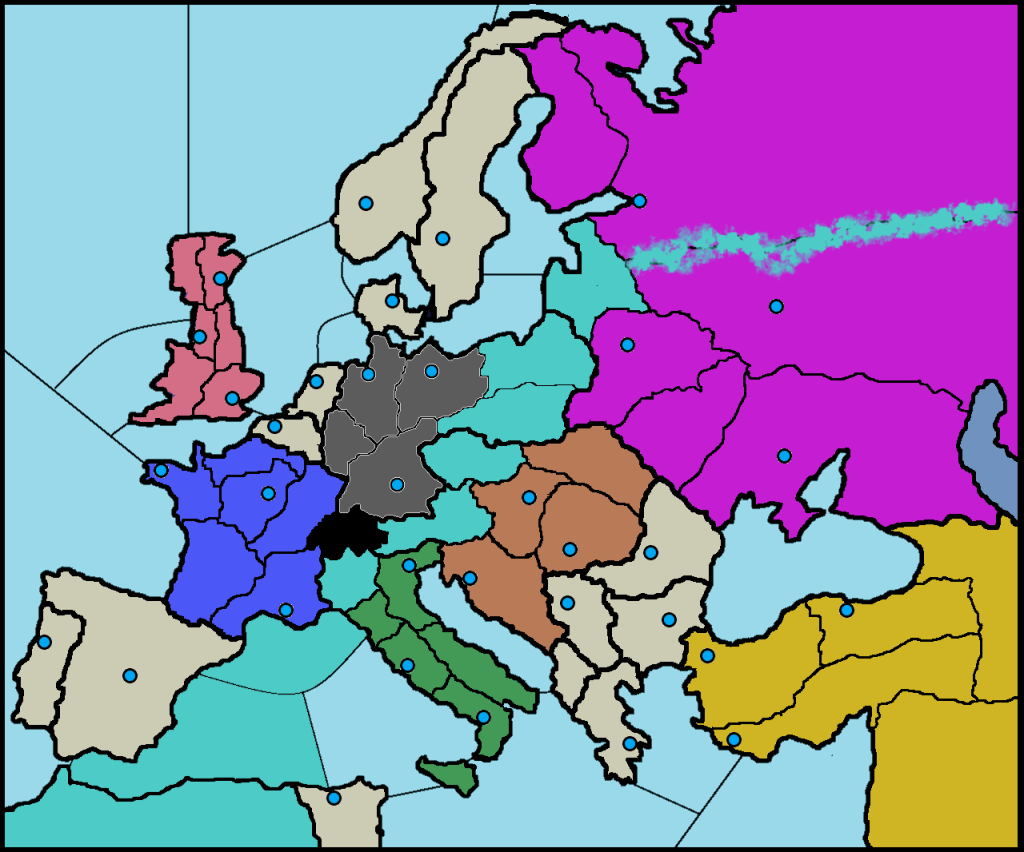
England and Turkey are the powers with the biggest job when it comes to crossing this line. Neither is close to it; both have powers in the way. This is one of the reasons England and Turkey find it tough to win games.
But win they do. For England, if they can take all 17 SCs on their side of the board, they will be looking Moscow, Warsaw or Tunis as first choice for the 18th SC. For Turkey, it’s St Petersburg, Spain, Marseilles, Munich or Berlin.
It’s still pretty difficult to get to this point, though, and often you’ll need more than one of the SCs on the other side of the board.


 THE DIPLOMATICON
Leave a comment