

- Power: England
- Group: Southern openings
- When: Spring 1901
- Target SC: Norway, Brest, Belgium
- Aggressive towards: France, Russia, Germany
- Orders: F Edi-NTH, F Lon-ENG, A Lpl-Yor
This Southern opening is named after the river that flows through York, the Ouse (or Great Ouse – I wasn’t calling it the Great Ouse Opening, though, because, well, it isn’t all that great). In this opening, then, England orders A Lpl-Yor.
In some ways this is no different to the Leith Opening. With the Leith Opening, England orders A Lpl-Edi, presumably because the plan is to convoy the army to the continent – Belgium or Holland – or Scandinavia – Denmark (yes, I know Denmark isn’t a Scandinavian country but it’s known as such in Diplomacy) or Norway.
Ordering A Lpl-Yor presents exactly the same set of options. Is there any advantage to either?
The Stay-at-Home Army
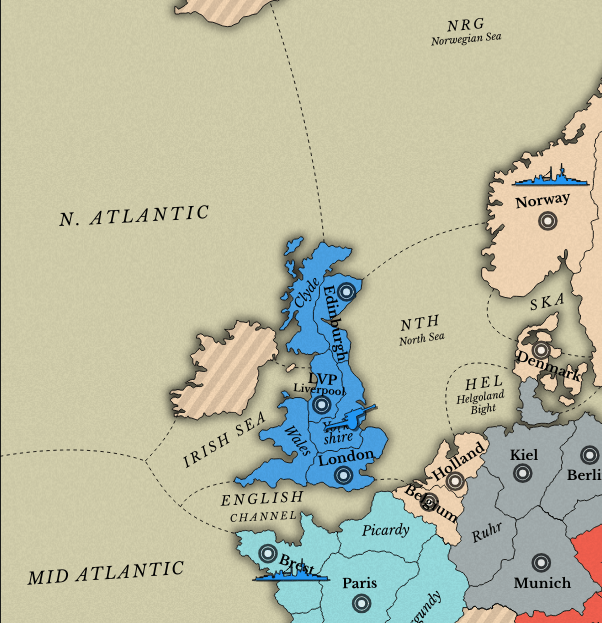
Here’s a slightly idealised… OK, a very idealised version of what post-Fall 1901 might look like. England opened with the Ouse Opening and then moved F ENG-Bre and F NTH-Nwy successfully. A(Yor) stayed in Yorkshire. Why?
I’m a fan, with England, of building fleets. For me, England needs to dominate the seas. It’s about both defence and offence. Defensively, other players have to get fleets around England to defeat you. There’s literally no other way to capture your SCs. If you dominate the seas, they can’t do that.
In terms of offence, you need fleets to get your armies on the continent. You could win the game by just building fleets. But you’d need to be lucky. That’s a large number of coastal SCs to succeed. To count those coastal SCs in moderately easy reach: St Petersburg, Norway, Sweden, Denmark, Berlin, Kiel, Holland, Belgium, Brest, Spain, Portugal, plus England’s three home SCs… that’s 15. Marseilles? Tunis? Naples? Rome? That’s 19. Doable, but you’re going to be lucky to break through both the Gibraltar Axis (MAO/Spain/North Africa/WMS) and the Skåne Axis (Denmark/Sweden). So you’re more likely to need to capture inland SCs, too, and that means armies.
I’m also a fan of getting England’s army onto the continent early if possible. You may as well get it into action. However, occasionally I’ll keep the army at home. This is simply another aspect of England’s defence, especially early in the game. If you’re not sure about what France is going to do, whether they’re friendly or not, then keeping your army in England allows you to defend the homeland. It’s also not something many players will expect, because getting it onto the continent is pretty much the accepted wisdom. “Pfft, look at him – no clue! Easy pickings!”
This is the only difference between the Ouse and Leith Openings: the Ouse Opening allows you to be more defensive. Unlike the Jorvik Opening, which also has A Lpl-Yor in S01, it isn’t needed immediately. In that opening, you move F(Lon) to the North Sea, leaving the Channel open for France to order F Bre-ENG. This threatens London, of course, so A(Yor) can be used to defend London. With the Ouse Opening, you’ve ordered F Lon-ENG so the Channel is occupied by your fleet (or, in the absolutely worst case scenario, defended due to a bounce with the French fleet); defending London in F01 isn’t necessary.
Honestly, I’d usually try to get the army on the continent. However, with my fleets having moved away from the Channel and – especially! – the North Sea, keeping the army at home is an extra layer of defence. Imagine succeeding with F NTH-Nwy only to see Germany order F Den/Hol-NTH… and you’ve convoyed your army to Brest, Picardy or Belgium! Well, yes, of course, you can build a fleet in London or Edinburgh (and possibly both) but that means Germany has dictated what you need to build.
Taking Belgium
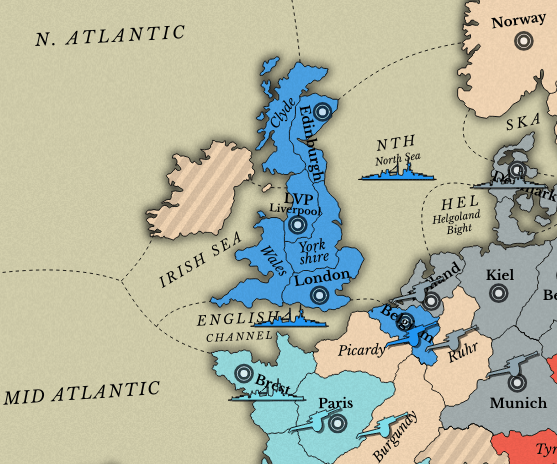
Above I’ve illustrated something that’s worth considering if you’re trying to take Belgium following an Ouse Opening (or, indeed, any Southern opening). Let’s set the context.
In Spring 1901, France ordered F Bre-MAO, A Par-Bur, A Mar-Gas. Germany ordered F Kie-Den, A Mun-Ruh, A Ber-Kie.
In Fall 1901, England ordered F NTH C Yor-Bel, F ENG S Yor-Bel. France ordered F MAO-Por, A Gas-Spa, A Bur-Bel – greedy! Germany ordered F Den-Swe (bouncing with Russia’s F GOB-Swe), A Ruh S Kie-Hol (not concerned with France trying for Munich and wanting to ensure they took Holland just in case you tried for it).
In Winter 1901, France built F(Bre) and A(Par); Germany built A(Mun). It doesn’t matter what Germany built as a second unit, and I haven’t included England’s build because I don’t need to talk about it – it would probably be a fleet in London.
And so we have three German armies in a line along what might be considered the border with France. We have a second French fleet in Brest, which is a clear threat to England, and a third army built in Paris – defending against Germany?
What does this mean for you?
Well, frankly, nothing good. Germany wasn’t worried about France in 1901 and, although they may be concerned now, the army in Munich was probably a given, if only because building A(Par) was probably what France would do anyway. Germany has two units bordering Belgium, and F(Den) bordering the North Sea.
France, with their fleet build, is clearly worrying. It can’t move to the Channel but they have a fleet in Portugal too, remember: they could well be looking to move back into the Mid-Atlantic Ocean and F Bre S Por-MAO can’t be stopped. In the meantime, A Bur S Par-Pic would put two French units bordering Belgium, too… and they may well seek to guarantee that move with F Bre S Par-Pic. Or how about F Bre-ENG? Whatever, F(Bre) is left bordering the Channel.
There is a better than even chance you’re going to lose Belgium. You can hold Belgium if you use both fleets to defend it, of course. But F Bre-ENG cuts that support, and F Den-NTH cuts that support. It could be that France or Germany will support you in Belgium, too, but it’s looking like France and Germany might well be working together. So where does A(Bel) go, assuming it’s dislodged?
The solution to this likely dislodgement is to convoy your army out of Belgium before it happens. But where? Norway is a possibility but, by this time, Russia may well have a unit bordering Norway. Will they let you in? (They probably should, in fairness, simply because Germany is going to need somewhere else to go if they and France eliminate you, and Russia is a good option.) What about Yorkshire, London or Wales? Well, yes, that would work… but then you’ve wasted time putting it in Belgium in the first place! Perhaps it can move to Picardy? Not if France is determined to succeed in occupying Picardy, no, and isn’t stopped by German action.
This is the problem with landing an army in Belgium: there’s nowhere to go if you’re attacked by a Franco-German alliance, or by a France or Germany dedicated to taking Belgium. Think of the problem Britain had in WWII when the expeditionary force landed in Dunkirk. While your fleets mean your army isn’t exactly isolated, with no defence, fleet defence in this case is easily neutralised.
In this scenario it is probably better to let your army be dislodged and disband it. If you get the chance, perhaps from Norway, you can build a new fleet in its place. You’re going to need the strongest defence you can muster!
For me, then, while an army in Belgium is the best option for an alliance with France against Germany, or an alliance with Germany against France, if you’re going to take Belgium and you’re not convinced that your ally is really your ally, or not prepared to gamble that they are, take it with a fleet. The fleet has a better chance of finding a retreat if it’s dislodged, and is better defensively if it’s dislodged.
Better still, leave France and Germany to fight over Belgium and do something different. Belgium is a good, and a usual, second SC for England to take in 1901 (after Norway) but Belgium is one of those spaces that changes hands a lot in the Early Game.
POSTS IN THIS SERIES
- England’s Opening Moves – Introduction
- Churchill Opening
- Jorvik Opening
- Leith Opening
- Ouse Opening
- Severn Opening
- Grampian Opening
- Pennine Opening
- Snowdonia Opening
- Western Opening
- Yorkshire Pudding Opening


 THE DIPLOMATICON
Leave a comment