
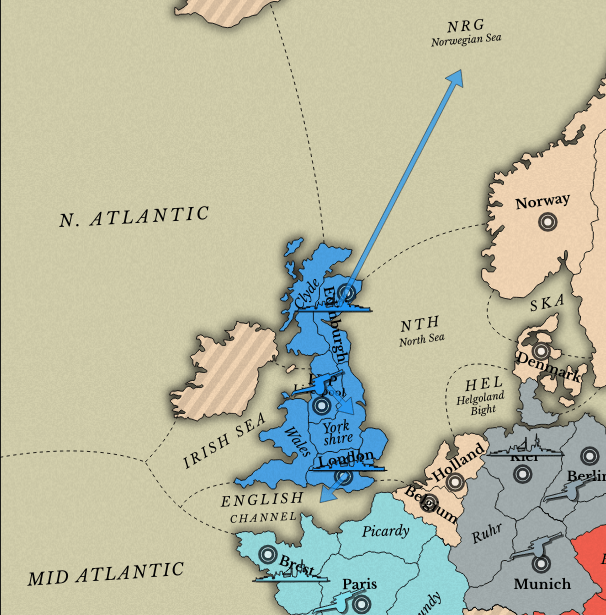
- Power: England
- Group: Splits openings
- When: Spring 1901
- Target SC: Norway
- Aggressive towards: France, Russia
- Orders: F Edi-NWG, F Lon-ENG, A Lpl-Yor
The Pennine Opening is named after the range of hills (they’re not really mountains) known as the Spine of England: they form the border between Lancashire and Yorkshire (the historical county of Yorkshire is now split into North Yorkshire, West Yorkshire, South Yorkshire and, yes, East Yorkshire). In the Pennine Opening, then, England’s army moves to Yorkshire.
The Pennine Opening isn’t often recognised as an opening at all. The Library of Diplomacy Openings recognises it (and calls it the Yorkshire Variant). However, in “The Game of Diplomacy” Richard Sharp completely discards this opening:
“The remaining option is the one sometimes called The Splits – F(Lon) -ENG, F(Edi)-NWG – with the army going to either Edi or Wal (incredibly, there are three recorded cases where it has moved to Yorkshire).”
“The Game of Diplomacy” Ch 4 “England”. Sharp, R. Arthur Barker, 25 Jan 1979. Accessed from https://diplomacyzines.co.uk/home/contents/the-game-of-diplomacy/4-england/ 7 July 2024.
I don’t really have a great opinion of the Splits openings at all, so why on Earth would anyone use the Pennine Opening? After all, the army occupying Yorkshire can’t move overseas: it’s completely separated from the fleets.

The (Uncertain) Anglo-German Alliance
The Splits openings are very pro-Germany. In his book, Sharp actually says they’re: “pro-German to the point of grovelling.” This might be a little overstated… OK, no it isn’t. If you use this opening you’re showing Germany that you’ll do whatever they want.
Above, though, is an example of the Pennine Opening with a confident Anglo-German alliance. It looks like England and Germany have persuaded France that there’s a Western Triple in play: why else would France have moved both their armies south, aiming to take Iberia (Spain and Portugal) with their armies, and their fleet to the Mid-Atlantic Ocean, ready to push into the West Mediterranean Sea?
They’ve been stung, though. England’s moved into the Channel, and threatens Brest. Germany’s moved into Burgundy and threatens both Marseilles and Paris. France is going to lose at least one home SC unless they reverse all three of their orders, ie F MAO-Bre, A Gas-Par and A Spa-Mar. And, if they do that, they risk Germany getting three builds – F Den H, A Bur-Bel and A Ruh-Hol – while England moves F ENG-MAO and, from there, F MAO-Por. Alternatively, of course, Germany could move A Bur-Pic (to support England into Brest later and keep the pressure on Paris) or A Bur-Gas (to threaten Spain, Paris, Marseilles and Brest).
With this plan, England might have been better to move A Lpl-Wal (the Snowdonia Opening). They could then have ordered F ENG C Wal-Bre to take Brest. This, however, would have given France a strong indication that England was attempting this move, which would likely solidify France’s decision to order F MAO-Bre. Without this, with A Lpl-Yor, France has doubts: Is England going to move F ENG-Bre or F ENG-MAO?
We’re talking about England here, so let’s look at this option from England’s point of view. France might try any of these orders:
- F MAO-IRI, A Gas-Bre. This puts the French fleet in a position to threaten Liverpool and covers Brest. If England faces a Russian army in St Petersburg, this may well be the best move – England may not be able to build so Liverpool is undefended… except for A Yor-Lpl in Spring 1902, of course. (A Wal-Lpl would do the same.) So… F ENG-MAO.
- F MAO-ENG or F MAO H. This gambles that England will try F ENG-MAO. If France thinks this is the case, they may not cover Brest; the play here is that England’s attempted move means Brest doesn’t need covering. In that case, F ENG-Bre is England’s option; A(Gas) may well try to defend Paris or Marseilles.
- F MAO-Por of F MAO-Spa(nc/sc). In this situation, England should probably try for F ENG-Bre because moving to the Mid-Atlantic isn’t much use: you’re not getting Spain or Portugal so you may as well try for Brest. On the other hand, France may well decide to order A Gas-Bre simply to spite you. If this is the case, F ENG-MAO is better: at least from there you can support a fleet into the English Channel from London (assuming you can build one, of course).
In any of these situations, A Lpl-Wal would give England an additional option, unless England is looking to move to the Mid-Atlantic, of course. Still, if France takes the first option above, A(Wal) can defend Liverpool just as well as A(Yor).
So much for the Anglo-German options against France. What might make England order A Lpl-Yor and not A Lpl-Wal? Some uncertainty about the alliance can be the only answer.
Look at the map above again. Unlikely, but potentially, this is a Franco-German alliance, if a very flamboyant one! Imagine the following position after Fall 1901:

The problem now is that England’s stuffed, of course. They’re going to lose two SCs in 1902. A(Yor) can’t defend all three home SCs and it doesn’t have to – F(NWG) can defend Edinburgh. However, F(IRI) has multiple options, especially assuming France builds F(Bre) and A(Par). F IRI-Lpl and F IRI-Wal can both be stopped by A(Yor) but it can’t prevent both. F IRI-ENG can’t be stopped at all. And F IRI S Bre-ENG is hugely dangerous as it allows A(Yor) make any move… but still means England is losing one SC.
In the meantime, Germany builds F(Kie) and – probably, as it keeps France onside better than A(Mun) – A(Ber). F(NTH) can convoy A(Bel) to either Edinburgh, Yorkshire or London. Assuming England uses A(Yor) to protect one of their home SCs, F NTH C Bel-Yor is a great order, if France focuses on getting the new fleet in Brest into the Channel. From there, England loses Edinburgh.
So, in the situation above – the nightmare – England has no hope. But ignore what else has happened and focus only on Germany’s order of F Den-NTH. In theory I’m a big fan of this order. If I’m Germany, I now have a great position – probably in preference of taking an SC, even. In practice, I’ve never done it… but that’s because I don’t really want to break a potential Anglo-German alliance. And this might be the reason why I can’t recall seeing anyone do it. But, well, yeah – great position.
Given that the Splits opening leaves the North Sea open for this move, there is an argument that A Lpl-Yor in S01 is actually a good move. Yes, A Lpl-Wal allows England to cover London… but not Edinburgh. And, while England will be looking to get a build from Norway, allowing a build in London or Edinburgh, it means the only build that makes sense is F(Edi). A(Yor) gives you some flexibility.
Of course, because you’ve used a Splits opening you must be pretty confident that an Anglo-German alliance is in play. The Pennine Opening isn’t great – but then no Splits opening is! And it doesn’t allow for a convoy. But it does give more security than either of the other two Splits openings.
POSTS IN THIS SERIES
- England’s Opening Moves – Introduction
- Churchill Opening
- Jorvik Opening
- Leith Opening
- Ouse Opening
- Severn Opening
- Grampian Opening
- Pennine Opening
- Snowdonia Opening
- Western Opening
- Yorkshire Pudding Opening


 THE DIPLOMATICON
Leave a comment