
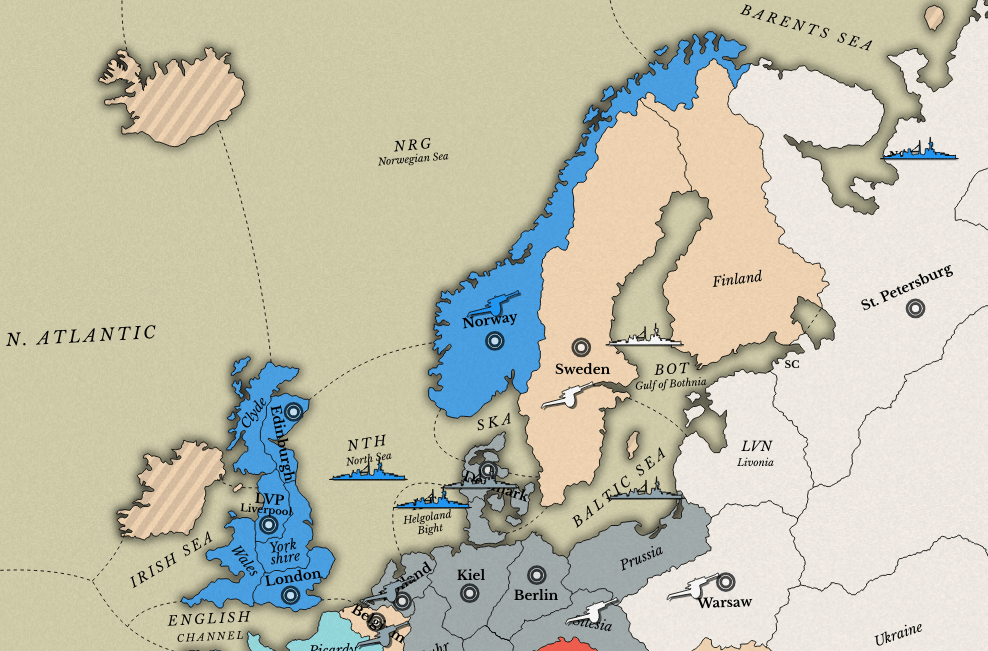
- Power: England
- Group: Northern openings
- When: Fall 1901 onwards
- Target SCs: Norway, St Petersburg
- Aggressive towards: Germany
- Extension of: Churchill Opening, Jorvik Opening
Hang on. What? The target SCs are Norway and St Petersburg – how can this opening not be aggressive towards Russia!?! Good question.
Look at the map above. It looks a real mess. What’s England doing? Have they started with an E/G alliance against Russia, and then stabbed Germany? Not the way to play the game. We often call aggressive players ‘Sharks’ but this isn’t Shark play – this is idiocy!
Well, what’s actually happened is the formation of an E/R alliance aimed against Germany. And one that has the chance of being very successful. The key to it? Russia agreeing to England taking St Petersburg (as well, in this example, as England landing an army in Norway!).
The opening is named after the Russian city on the Barents Sea, Arkhangelsk.
On Angel’s Wings
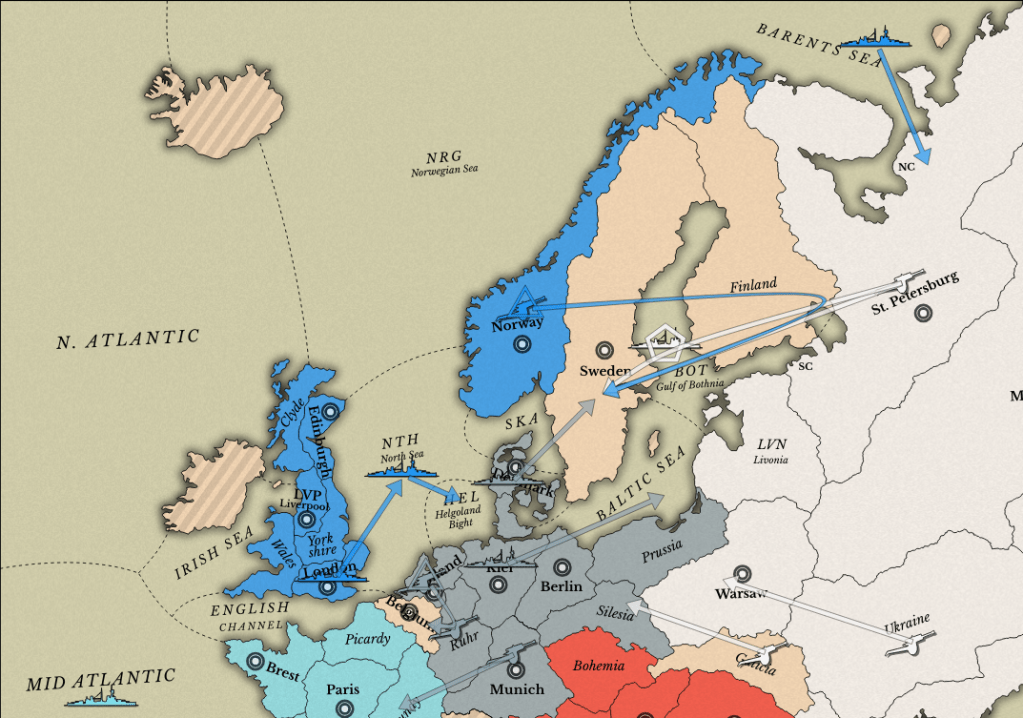
Here are the important moves:
Spring 1901
- England: F Edi-NWG, F Lon-NTH, A Lpl-Yor/Edi
- Russia: F Stp-GOB, A War-Gal, A Mos-Ukr
- Germany: F Kie-Den, A Ber-Kie, A Mun-Ruh
Fall 1901
- England: F NWG-BAR, F NTH C Yor/Edi-Nwy
- Russia: F GOB-Swe (really doesn’t matter what A(Gal) and A(Ukr) do, although we assume they stay in place, so probably supporting the southern fleet into – or in – Rumania)
- Germany: F Den-Swe, A Ruh S Kie-Bel
This gives us the following position, after these builds:
Winter 1901
- England: F(Lon)
- Russia: A(Stp)
- Germany: F(Kie), A(Mun)

What has England done to get into this position?
Well, they’ve started by agreeing an alliance with Russia. The terms are that England gets St Petersburg in return for Russia gaining a secure alliance with England and gains against Germany. Why would Russia agree to this? Because they can use the E/R alliance to gain German SCs – Berlin, Munich, Kiel, Sweden and Denmark – while England gains the Low Countries, Norway and St Petersburg, and a free shot on France.
However, the alliance has been built on deception. In this example. England opens very aggressively towards Russia, convoying their army to Norway and pushing through to the Barents Sea. Russia, therefore, needs to be completely aware of this opening, and that it isn’t a threat. That takes a huge amount of trust and incredible English diplomacy!
Perhaps what might sell this is England not only agreeing to the Russian build of A(Stp) in W01 but suggesting it. If this version of the Arkangel Opening is to be successful, the board – and certainly Germany – needs to believe England is attacking Russia. This isn’t going to work if Russia doesn’t look as if they’re protecting St Petersburg.
What’s next? (This is a very extended opening!)
Spring 1902
- England: F BAR-Stp, A Nwy S Stp-Swe, F NTH-HEL, F Lon-NTH
- Russia: F GOB C Stp-Swe, A Gal-Sil, A Ukr-War
- Germany: F Den-Swe, F Kie-BAL, A Mun-Bur, A Hol S Ruh-Bel
When this is resolved you get:
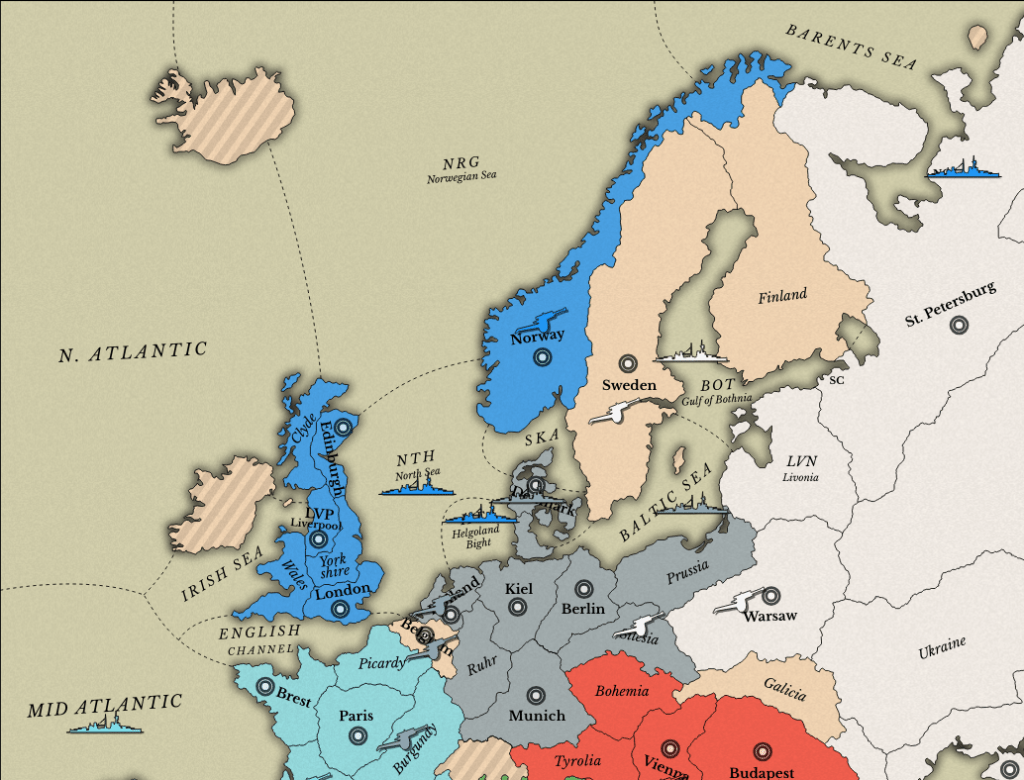
Immediately you can see that Germany is wide open. The Russian army in Silesia can strike at either Berlin or Munich. Both can be covered by F BAL-Ber and A Bur-Mun. But that doesn’t prevent A War-Pru from Russia, leaving two Russian units covering Berlin. Russia will try for A Sil-Mun to prevent Germany moving A Bur-Mun. That gives Russia success in taking Berlin if they’re able to successfully order F GOB-BAL.
Germany could try to take Sweden, but England supports A Swe H… or supports A Swe-Den, and Russia orders F GOB-Swe (with England ordering F NWY S GOB-Swe).
England’s fleets threaten Denmark, Kiel and Holland. If Russia orders A Swe S NTH-Den, it can’t be stopped – giving England a chance of taking Holland or Kiel. Germany simply can’t cover Holland, Kiel and Denmark in one go.
Too Much?
It’s possible that this version of the Arkangel Opening is too aggressive, on England’s part, to facilitate an E/R alliance. Russia is putting a lot of trust in England!
To counter this, England could order F NTH-Nwy in F01. That still doesn’t allow Russia to defend St Petersburg if they believe England is really attacking them, though, and if Russia is concerned that England isn’t serious about an alliance, they’re not going to agree to this opening anyway.
The problem with F NTH-Nwy is that it takes that fleet out of position to take the Heligoland Bight. It can, of course, still get into Skagerrak but Heligoland is the better space to occupy to attack Germany – more options.
Selling the anti-Russian opening is the key to the Arkangel Opening. Germany needs to believe they have England on their side or the moves away from the Germany centre don’t happen. If this is going to work, Germany needs to trust that England is working with them.
Perhaps the most difficult part of this sale is getting Russia to agree to give up St Petersburg in the first place. While they are still able to get across the Neutral Zone – they’re going to have Germany to themselves! – at the start of the game it feels as if giving away St Petersburg is giving up this chance.
Russia is also giving away security in the East to make this play. This isn’t an easy thing to do. However, one solution to this is for Russia to sell Austria and Turkey on letting them have Rumania, the two of them doing whatever they want, while Russia plays in the north.
POSTS IN THIS SERIES (Links marked with [X] indicate extensions to the initial openings.)
- England’s Opening Moves – Introduction
- Churchill Opening
- Jorvik Opening
- Leith Opening
- Ouse Opening
- Severn Opening
- Grampian Opening
- Pennine Opening
- Snowdonia Opening
- Western Opening
- Yorkshire Pudding Opening
- The Levy Opening [X]
- The Arkangel Opening [X]
- The Norwegian Gambit [X]


 THE DIPLOMATICON
Leave a comment