
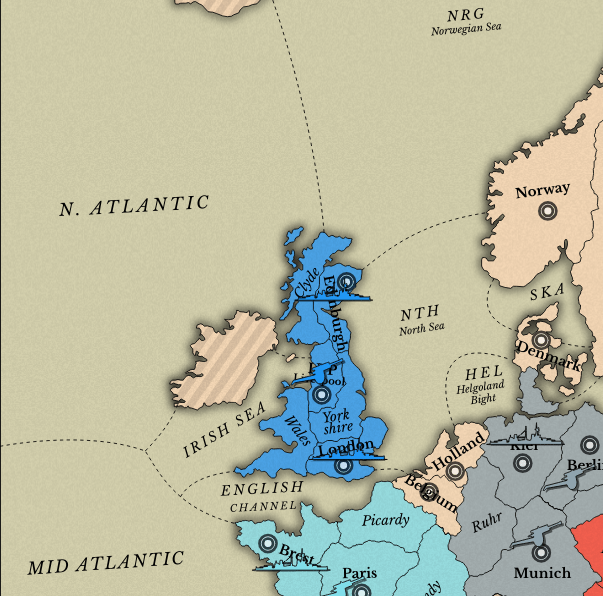
England has, altogether, 125 possible moves. Each unit can move to four spaces and or be ordered to hold. Of these, there are ten that deserve some attention, but only five that make a lot of sense.
I’m going to discuss nine of these in this series. Just to lay them out, here’s a table (you can’t beat a table, can you?):
| Group | Name | F London | F Edinburgh | A Liverpool |
| Northern openings | Churchill Opening | – North Sea | – Norwegian Sea | – Edinburgh |
| Jorvik Opening | – North Sea | – Norwegian Sea | – Yorkshire | |
| Southern openings | Leith Opening | – English Channel | – North Sea | – Edinburgh |
| Ouse Opening | – English Channel | – North Sea | – Yorkshire | |
| Severn Opening | – English Channel | – North Sea | – Wales | |
| Splits openings | Grampian Opening | – English Channel | – Norwegian Sea | – Edinburgh |
| Pennine Opening | – English Channel | – Norwegian Sea | – Yorkshire | |
| Snowdonia Opening | – English Channel | – Norwegian Sea | – Wales | |
| Other openings | Western Opening | – English Channel | – Clyde | -Wales |
| Yorkshire Pudding Opening | – Yorkshire | – Yorkshire | – Yorkshire |
I’m not going to discuss the Yorkshire Pudding Opening in any great depth; I’m only mentioning it because it has a certain notoriety.
There are also a number of Extension openings that will be discussed as part of the main posts. Here’s another table:
| Group | Name | Objective(s) |
| Northern openings | Levy Opening | Anti-Russian Norway, Sweden, St Petersburg |
| Arkangel Opening | ||
| Hugg Opening | ||
| Scandinavian Snatch | ||
| Atlantic Switch | ||
| Mckejo Opening | ||
| Copenhagon Combo | ||
| Norwegian Gambit | ||
| Southern / Splits / Western openings | Plantagenet Opening | |
| Hey Bresto Opening | ||
| Atlantic Bind |
Given that the main focus of this series is choosing an opening to fit your objective(s), it is the Extension openings that will take centre stage.
So these openings won’t be discussed in isolation. Rather, I’ll look at them from the point of view of where England aims to go, which powers they should be allied with, and which openings are most effective in achieving the objective.
But first, let’s have a look at the three main groups of openings.
Northern openings
There are just two of these, but eight Extension openings. This should tell you that England often uses a Northern opening in games. This isn’t really surprising: England needs a build in 1901 and a Northern opening is the only way to guarantee one – Norway.
The two Northern openings are:
- The Jorvik Opening: F Lon-NTH, F Edi-NWG, A Lpl-Yor (also known as the Northern Opening and the Yorkshire Opening).
- The Churchill Opening: F Lon-NTH, F Edi-NWG, A Lpl-Edi.
There has been a lot of discussion about which of these is the better choice, as either could often be used in an Extension opening.
The advantages of the Churchill Opening is that, from Edinburgh, your army could be convoyed by either fleet. This is held, by some, to make it more flexible than the Jorvik Opening. It depends what you mean by ‘flexible’, I suppose. If you’re only interested in having an option, in F01 ordering F NTH C Edi-Nwy allows you to also order F NWG-BAR, gaining an advanced position of F(BAR) and A(Nwy) against Russia (both border St Petersburg).
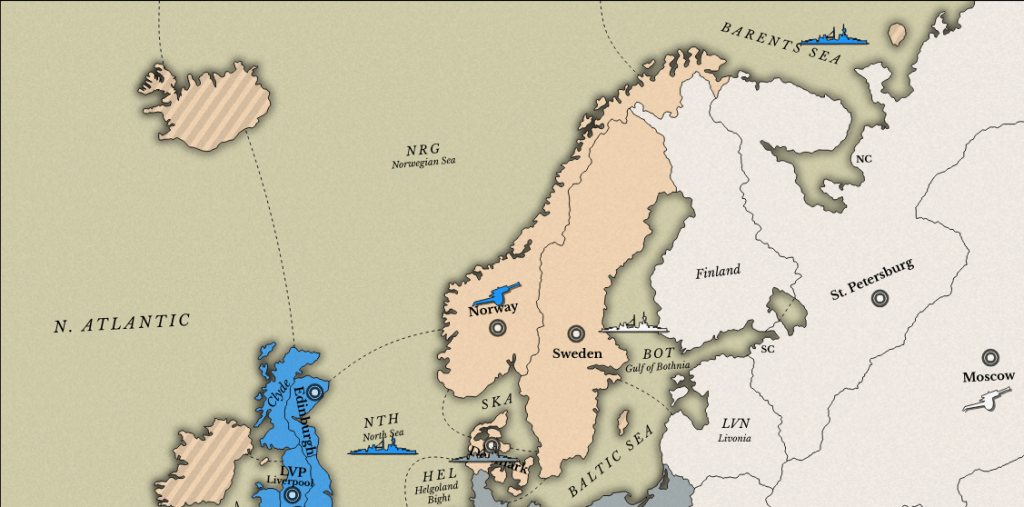
The Jorvik opening, however, also allows you to achieve this position, convoying from Yorkshire in this case. I suppose, if this is what you aim to do, ordering A Lpl-Yor, only allowing for a convoy via the North Sea, indicates that you’re more likely to order F NWG-BAR.
The Jorvik Opening, though, has two advantages over the Churchill.
Defending London
The problem with either Northern opening is that it leaves the English Channel empty. If France decides to order F Bre-ENG, you’ll find yourself with a French fleet sat right next to London.
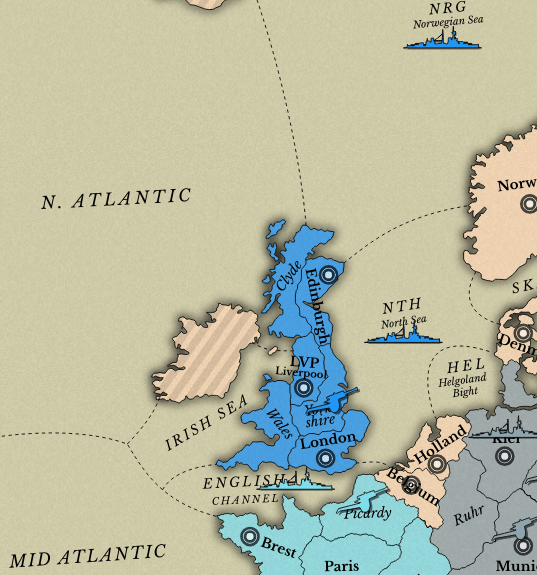
What now? Well, with A(Yor), if necessary, you can defend London with A Yor-Lon in F01. If you’ve used the Churchill Opening, your army – in Edinburgh after S01 moves – can’t do anything about this! I mean, of course, your diplomacy will be aimed at persuading France they don’t want to move into the Channel, but you never know…
Guaranteeing Norway
Norway is the only supply centre you can guarantee taking in 1901. There is, in fact, just one combination of orders that allows you to take Norway successfully (albeit in the absolute worst case scenario).
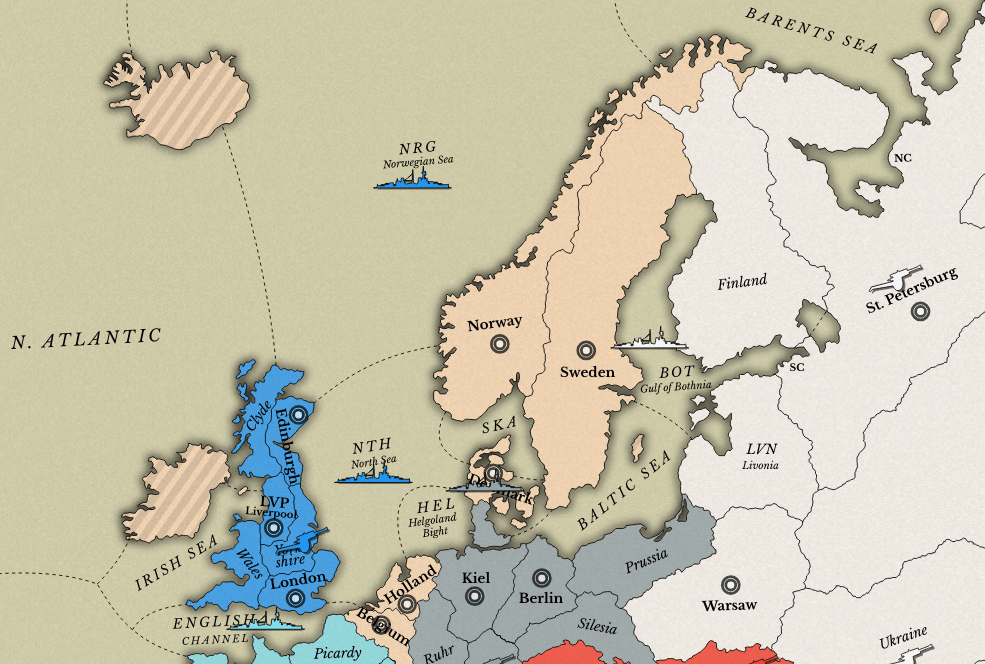
The first problem is if Russia opens with A Mos-Stp. This means that they can (and probably will, no matter what they tell you) order A Stp-Nwy in F01. If they do so, you’re going to need to take Norway using both fleets. On its own, you can use either fleet to support the other to Norway, or you can use F NTH C Yor-Nwy and F NWG S Yor-Nwy.
But let’s look at other possibilities. France has a fleet in the Channel; Germany has a fleet in Denmark. What happens if either fleet is ordered to the North Sea and Russia orders A Stp-Nwy?
Well, in this scenario, using F NTH S NWG-Nwy will fail: support if cut by either F ENG-NTH or F DEN-NTH. In this case, then, only two possibilities succeed:
- F NWG S NTH-Nwy, or
- F NTH C Yor-Nwy, F NWG S Yor-Nwy
The support from F(NWG) can’t be cut.
And now we’re at the worst case scenario, mentioned above. Here, there’s a possible German Ocean Triple alliance against you! Here are the alliance’s orders:
- Russia: A Stp-Nwy
- Germany: F Den-NTH
- France: F ENG S Den-NTH
Now, your fleet in the North Sea is dislodged, unless you order F NWG S NTH, F NTH C Yor-Lpl… but A Yor-Lpl is bounced by Russia’s A Stp-Mos.
What we have, then, is just one option: F NWG S NTH-Nwy (and, I suppose, A Yor-Lon). This, then, is the only way England can guarantee gaining Norway.
A Little Perspective
OK, so the above set of moves is unlikely. In fact, it’s pretty rare for an anti-English GOT alliance to form. The more unlikely aspect of the above is for either France or Germany to order a fleet to the North Sea (which is surprising because it has a good chance of success!); the most unlikely is for either France or Germany to support the other to the North Sea.
Remember, though, that we’re looking at which of the two Northern openings is the better. From this point of view, the Jorvik is superior; I’d even suggest it is the more flexible of the two by virtue of allowing you to defend London with A(Yor) if needed.
It’s worth remembering, though, that there really is no ‘best option’ in a game, unless it involves a consideration of what you’re going to do, which means taking your diplomacy into account.
Southern openings
I mentioned above that using a Northern opening runs the risk of France ordering F Bre-ENG and it being unopposed. One solid way to avoid this threat is to order F Lon-ENG, an order that is consistent in all the remaining openings, whether Southern, Splits, or Western. (Not with the Yorkshire Pudding Opening, of course, but that’s an opening that’ll get you battered!)
The Southern openings are all named after rivers: the Leith flows through Edinburgh, the Ouse through York, and the Severn rises in south Wales.
- The Leith Opening: F Lon-ENG, F Edi-NTH, A Lpl-Edi (also known as the Edinburgh variant).
- The Ouse Opening: F Lon-ENG, F Edi-NTH, A Lpl-Yor (also known as the Southern Opening or the Yorkshire Variant thereof).
- The Severn Opening: F Lon-ENG, F Edi-NTH, A Lpl-Wal (also known as Welsh Opening).
Honestly, the difference between these openings is sometimes negligible. If you use the Leith Opening, you’re clearly looking to convoy A(Edi) – there’s no reason for it to be there otherwise. Similarly, A(Yor) is likely to mean the same thing. Either opening allows you to convoy to one from Norway, Denmark, Holland, or Belgium (and even to Picardy or Brest if the Channel fleet is also involved!).
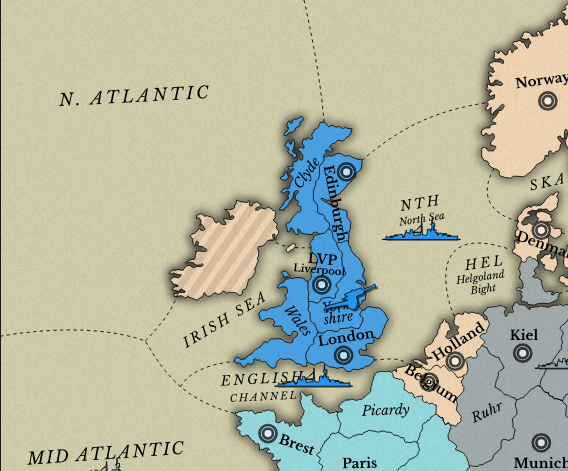
The only difference between A(Edi) and A(Yor) is a defensive one. If you’re thinking of keeping an army at home (for some reason) then the army is better in Yorkshire than Edinburgh for two reasons:
- A(Yor) isn’t occupying an SC so you’re not restricting your build options (should you get one!), and
- From Yorkshire, your army can defend all three home SCs.
By contrast, the Severn Opening is much more aggressive, in appearance, towards France. Take a look at the position:
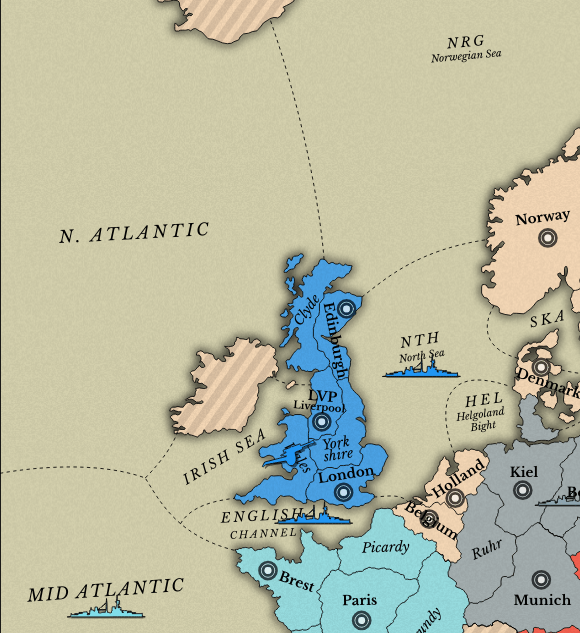
See what I mean? Look at the options for A(Wal):
- F ENG C Wal-Bre
- F ENG C Wal-Pic
- F ENG C Wal-Bel
This isn’t to say that you couldn’t convoy to Belgium by starting with a Northern opening – you could! And, of course, with the Leith and Ouse openings, you could have convoyed to Belgium (and supported this from the Channel). But there’s something a little more… ominous? – about the Severn Opening – if you’re France.
The Problem with F Lon-ENG
Many people would encourage F Lon-ENG. If you don’t order this (which should mean F Lon-NTH) you’re heading in the wrong direction. “France,” they’ll tell you, “is your natural enemy if you’re playing England.”
Tactically, considering the board alone, they’re correct. France is the one power that could sneak units behind your lines. With a home SC bordering the Channel and the Mid-Atlantic Ocean, it doesn’t take much for them to have a fleet in MAO, one in Brest, and suddenly the Channel, the Irish Sea and the North Atlantic Ocean are all vulnerable… which in turn makes Liverpool or London vulnerable.
And, of course, there’s the old problem of France being the most successful power in Diplomacy. This makes it important, as England, to manage France’s growth and success – and there’s no better way to do that than getting rid of them.
You know what, all of this makes sense. What doesn’t make sense about it is that it doesn’t consider who is playing France. Just as there’s no ‘best opening move’ for England without considering what you want to achieve, there’s no ‘best ally’ or ‘best target’ for England without considering the players in control of the powers.
If, however, you are attacking France, F Lon-ENG is a key move almost regardless of what you want to do with it afterwards. The problem is that the move comes with risk.
If you’re England and you’re convinced France will order F Bre-ENG, it’s usually best to let them. A Lpl-Yor will safeguard you from F ENG-Lon in F01, should France try that (and it’s pretty rare that they will).
The alternative, of course, is F Lon-ENG, bouncing with F Bre-ENG, and causing both fleets to remain in their respective ports. For England, this is a possible disaster; for France, merely an inconvenience.
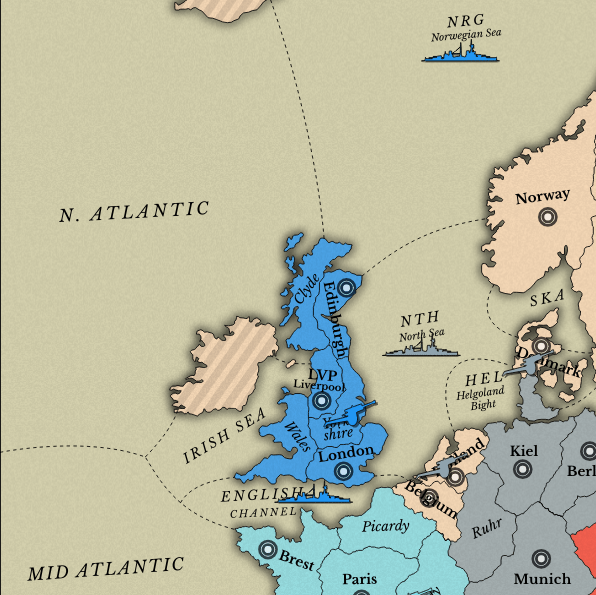
Let’s look at the possible position if you, as England, decide to bounce France in the Channel:
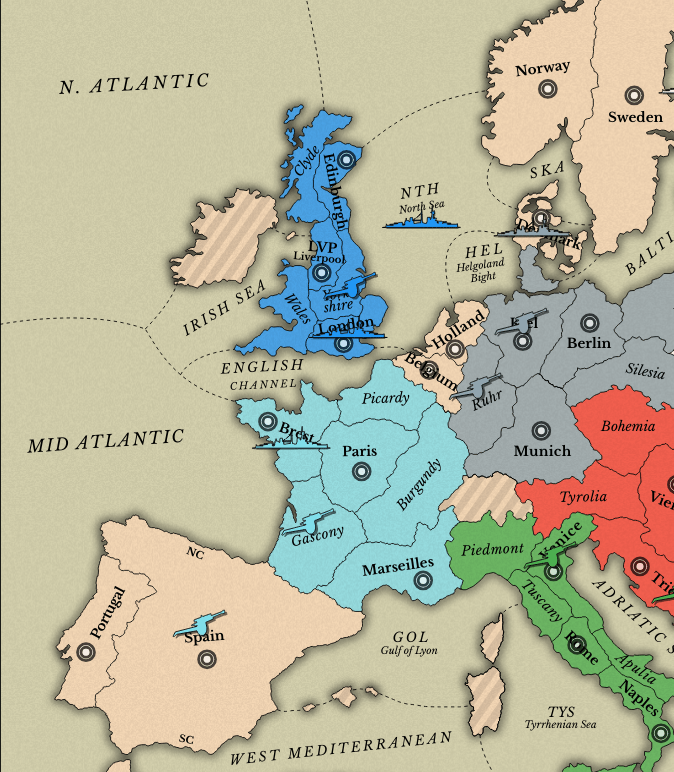
France has played it risky: A Par-Gas and A Mar-Spa. They might have found a German army in Burgundy. Instead, Germany ordered A Mun-Ruh, A Ber-Kie, and A Kie-Den.
The situation for France is much more favourable. Yes, F(Bre) is stuck in place when it could have been in MAO or Picardy. But France still has two builds as an option by capturing Portugal and Spain. France can now move F Bre-MAO in F01, and Brest will be open for a new fleet build. Admittedly, they got away with it; A Mun-Bur from Germany would have been much more of a problem.
Frankly, though, had France decided to protect Burgundy by ordering either A Par-Bur or A Mar-Bur; if they’d captured it by ordering A Mar S Par-Bur; or if they protected it by using A Par-Bur, A Mar-Bur, they would still have the chance for a build from Spain (and possibly one from Belgium).
Now compare this with England’s position. There’s a possibility of capturing Belgium, Holland, Denmark or Norway. Not from this particular position, though: Germany should probably order A Ruh S Kie-Hol to make sure of the SC. Given, though, that England can’t risk the bounce in either Belgium or Holland (no builds) Germany is probably pretty safe in ordering A Ruh-Bel, A Kie-Hol.
England’s last chance, then, is probably Norway… assuming Russia hasn’t ordered A Mos-Stp as discussed above. If they have, then you’re going to need to diplomatise your ass off to get a build.
And, in the meantime, F(Lon) hasn’t moved.
The facts are that a bounce in the Channel, in Spring 1901, isn’t good for either England or France. For France, though, it isn’t likely to prevent them building; for England, with F(Lon) being completely useless in S01, there is a high probability that you could miss out on builds altogether.
F Lon-ENG is a great move if it works… a disaster if it doesn’t. Which can you afford to risk?
Splits openings
I have never, to my lasting regret, been flexible enough to do the splits. Well, I say to my lasting regret – I actually regret never being flexible enough to do it, rather than regretting not being able to do it. I mean, once you’re there, then what?
This is somewhat allegorical for the Splits openings for England: once you’re there, then what? And why do it at all?
The Splits openings are named after mountain ranges (although it’s stretching it to call the Pennines ‘mountains’):
- The Grampian Opening: F Lon-ENG, F Edi-NWG, A Lpl-Edi (also known as the Edinburgh Variant).
- The Pennine Opening: F Lon-ENG, F Edi-NWG, A Lpl-Yor (also known as the Yorkshire Variant).
- The Snowdonia Opening: F Lon-ENG, F Edi-NWG, A Lpl-Wal (also known as the Wales Opening).
Honestly, there’s not much to be said about the possibilities that hasn’t been discussed above. But let’s consider one thing, here: what about the North Sea?
The North Sea
So, with the Splits, you don’t bother with occupying the North Sea. What does this mean?
What’s happened here? England used the Pennine Opening. In F01 you the orders were:
- England: F ENG-Bel, F NWG-Nwy, A Yor H
- Germany: F Den-NTH, A Kie-Den, A Ruh-Hol
- France: F MAO-Por, A Bur-Bel, A Mar-Spa
- Russia: F GOB-Swe, A Stp-Nwy
England was unlucky that they were bounced in Belgium by France. They could have ordered F ENG-Bre and succeeded; France knew this and made the correct 50/50 guess. Less unlucky was F NWG-Nwy bouncing with Russia’s A Stp-Nwy – once Russia ordered A Mos-Stp in S01, this was always likely.
It is Germany’s orders that did the damage, however. A Ruh-Hol and A Den-Kie are pretty standard orders; F Den-NTH is very much non-standard! But look at the position: that German fleet in the North Sea threatens London and Edinburgh, and can influence what happens in Belgium and Norway.
The North Sea is a key space for England. You don’t have to occupy it all the time, but you certainly don’t want someone else occupying it. And this is doubly dangerous in 1901! Where are you going to get SCs now? How are you going to persuade France and Russia that they shouldn’t ally with Germany?
A Splits opening is for someone who doesn’t know what they want to do… and they often end up narrowing your options down to nothing.
Army Options in a Splits Opening
Above, I had the army move to Yorkshire. The reason for using the Pennine Opening is simply defensive: should the worst happen, and Germany occupies the North Sea, A(Yor) can defend London or Edinburgh on its own. If you get a build, then either London or Edinburgh is likely to be the place to build.
Of course, A(Yor) is useless in terms of getting it onto the Continent but, well, that’s the point. You’re covering your big Yorkshire ass.
The Grampian Opening, placing your army in Edinburgh, means you’re probably looking to convoy to Norway. The Snowdonia Opening – A(Wal) – suggests a convoy to Brest, Picardy or Belgium. Frankly, if you’re likely to get away with F NWG-Nwy, then you may as well go for Picardy as being the most likely to succeed (given that France may try to cover Brest and possibly take Belgium).
Frankly, though, if you’ve gone with the Splits, despite A Lpl-Yor removing the convoy option, defence could well be more important than anything else: at least Germany might temper their temptation to take the North Sea…
The Western Opening
There’s one place you never expect an English fleet to be in Fall 1901: Clyde. Well, there are other places, too, I guess.
Yorkshire in one such, despite the fact that both fleets could move there. Neither order makes any sense, however.
Wales is probably another space that should be fleet-less. F Lon-Wal doesn’t really do anything.
It is very common for England to get their fleets at sea in 1901 or, at least, try to. All too often you’ll see F Lon-ENG fail, and rather stupidly because someone thought they should stop F Bre-ENG.
Why, then, should F Edi-Cly be an option?
- The Western Opening: F Lon-ENG, F Edi-Cly, A Lpl-Wal.
With the Western Opening, you’re giving up on Scandinavia completely. In fact, you’re almost giving up on a build. You’re taking F(Edi) out to the reckoning for a possible SC gain and leaving just F(Lon) to do the hard work.
Why? To attack France, presumably. With a fleet in Clyde, you can move to the North Atlantic Ocean. This could well provide a great position if you can get a unit into Brest or Belgium (Brest, preferably, giving the westward leanings of this opening) and a build in Winter 1901.
The one advantage of this is that, if nothing else, it convinces Russia and Germany of your desire to attack France. If they thought you might be dithering, or otherwise insincere, they can’t deny your honesty now.
Or they could very well simply form a Domino alliance against you while you and France squabble over the strategically important, but non-SC supporting, MAO.
The Yorkshire Pudding
There is some question over whether the Yorkshire Pudding opening was played in a tournament or simply in a Postal Dip game. Maybe, I guess, a Postal Dip tournament..?
The Library of Diplomacy Openings says this opening was “Devised by Denis Jones“. ‘Devised’ might be a little… over-complimentary.
This is nothing more than a joke opening and, when it is used, it’s safe to say that the England player feels that they’re hilarious. Whether you’re France, Germany or Russia, it’s worthwhile forming the German Ocean Triple alliance to end your suffering as soon as possible.


 THE DIPLOMATICON
Leave a reply to Chris W Cancel reply