
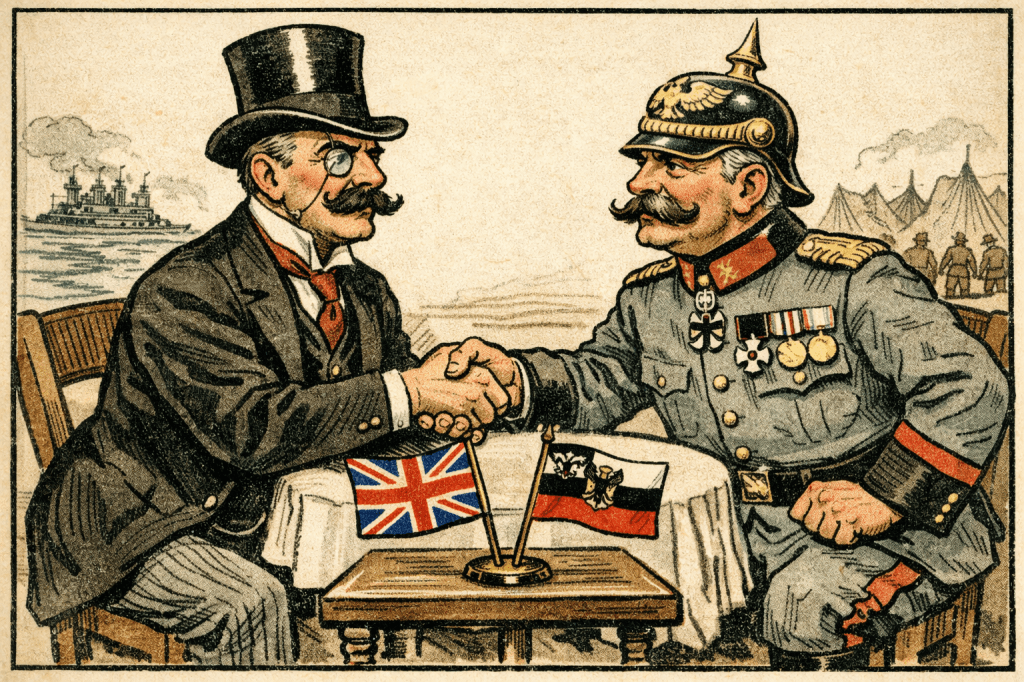
| Powers | England & Germany |
| Game stage | Early Game and beyond |
| Primary target | France; Russia |
| Alternative names | Anglo-German |
I like the Anglo-Saxon alliance, even if I don’t really like the name.
I get it, the name: the name ‘England’ comes from the name of one of the Germanic peoples that settled in Roman, and post-Roman Empire, Britannia. But, well, it’s a little clumsy. Still, I haven’t thought of a better one, and Anglo-German alliances are rare in history.
Which should probably tell us something about using the E/G alliance in the game. There are reasons there is no historical alliance of any significance between the two: mainly because ‘Germany’ didn’t exist. If it had, would any Anglo-German alliance have formed? Who knows? Given that, for most of history, Britain (well, England) and France were antagonistic towards each other, there’s a good chance.
Leaving aside imperialist competition and, later, ideological differences between Britain and the Germany that emerged in 1871, which has nothing to do with Diplomacy, there’s nothing strategically worse about the E/G alliance in comparison with the E/F.
Or is there???
East or West?
If this alliance forms, the two have to agree to contain France and attack Russia, or contain Russia and attack France. They can’t do both.
It doesn’t matter that they have just as many units in the region as France and Russia combined – and potentially more. Russia could move both their armies away from the north, and they usually move A(War) away. They have to the Low Countries (Belgium and Holland) and attack France, or move in force into Scandinavia. Doing both isn’t going to work.
Containment means keeping the ‘contained’ player as small as possible. France, potentially, will be at six units if E/G move on Russia: Spain, Portugal and Belgium. Russia might be on five units, depending on what happens in the south (taking Sweden but being at least held off in the Balkans), but will also usually be on six (with Rumania being captured).
It is possibly easier to contain Russia: they have to deal with the south, of course. If England and Germany can get Turkey and/or Austria to work against Russia there, this is where Russia’s attention will be. There’s little to be gained for Russia in being antagonistic against an Anglo-German alliance, and the Austro-Turkish threat is dangerous. Russia is more likely to be non-aggressive in the north.
Attacking France, however, can become something of a war or attrition. France is able to take Spain and Portugal in 1901 without much of a problem. While either England or Germany can prevent France getting into Belgium easily enough, especially if France goes after the Iberian SCs, breaking through the French defence can be difficult. Remember, England and Germany have to grow, too, and this often means England heading east to take Norway, while Germany heads north to take Denmark; Holland is the only SC that is in the right direction.
The key spaces
So where do the two powers need to move? It depends which of their two victims they’re going after.
Attacking Russia
England needs to get into Norway as a start, and Germany has to get into Denmark. Ideally, England should also have a fleet in the Barents Sea, ready to move into St Petersburg. In F01, Germany needs to bounce Russia from Sweden.
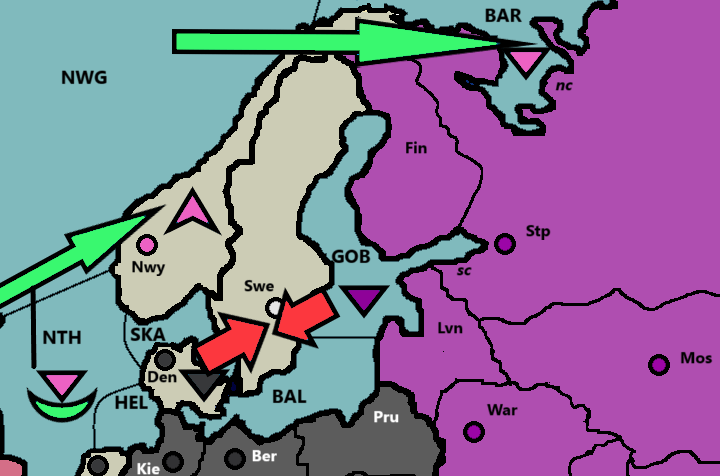
Warsaw is where Germany needs to go next, probably with two armies built in Munich and Berlin. England should move F NTH-SKA to support Germany into Sweden, and either take St Petersburg or move A Nwy-Fin and put a fleet in Norway in F02.
In the meantime, what is happening in the West? Well, not a lot. If both England and Germany are simply holding France at bay, 1901 is simple. A F/G bounce in Burgundy, perhaps. A DMZ (Demilitarised Zone) in the Channel. Does France take Belgium? Perhaps. England can’t do anything to prevent this, and Germany may not want to rock the appeasement boat by bouncing there.
This is laying up a more difficult war on France in the future, however, unless both England and Germany can spare some units to strictly limit France. This will depend on how well the war on Russia is going.
Attacking France
This is more problematic. The only thing they should make sure they’re doing is preventing France getting Belgium, and perhaps getting an English army in there.
England could go after the Channel but how? If England orders F Lon-ENG in S01, France is likely to also move F Bre-ENG. Neither wants the bounce so, if you’re determined, England, you’ll have to lie. Offer that DMZ straight away and then break the promise. A Lpl-Wal is also a good move. This really does tell France what you’re aiming for but, well, you’ve already lied, there’s no point in pussy-footing around, is there?
For Germany, it’s difficult to avoid the Burgundy bounce. You can’t leave Burgundy free to French occupation as Munich is too easy a target. Similarly, France can’t allow A Mun-Bur in S01 given that you would then be bordering both Paris and Marseilles.
You can see the options from here, following the above bounce:
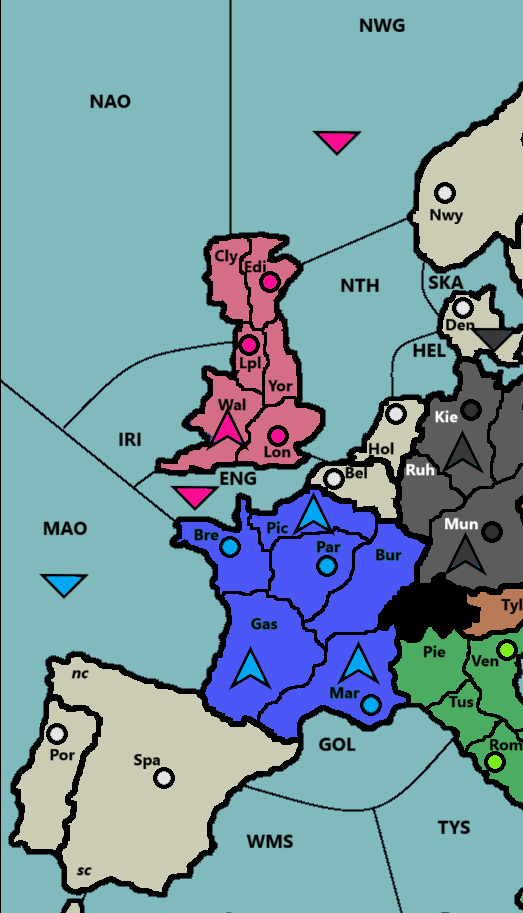
There are three French armies on this map, showing three possible positions – one in Marseilles and the other will be in either Gascony or Picardy, depending on what France is trying to do (France used A Mar-Bur to bounce with A Mun-Bur).
What does England do? A(Wal) could be convoyed to Brest, Picardy or Belgium. In this situation, if England doesn’t try for Belgium – either F ENG-Bel or F ENG C Wal-Bel – France can take Belgium with A Pic-Bel. That might be the best option for France – F MAO-Por, A Mar-Spa. This gives France a possible 3 builds, but they have to assume England order F ENG C Wal-Bre.
Does England try to take Brest? It isn’t guaranteed. Whether France has A(Pic) or A(Gas), they can bounce England from Brest. Given England’s violently anti-French opening, they’re likely to try for Brest. However, if England orders F ENG C Wal-Bel, then France will have an army in Brest and be unable to build in Brest to attack England.
How about Germany? Well, there isn’t a lot for Germany to do. A Kie-Hol is a given: there’s no way it can fail. That gives Germany two builds, regardless of what they do with F(Den). However, given that you’re trying to keep Russia happy, F Den H is the best option; you don’t really want to bounce Russia from Sweden! Which leaves A(Mun). What happens with this army depends on what else is happening but the idea is to go after France, so surely A Mun-Bur is given. This can be bounced again by a French army in any of the three SCs.
If France has moved A Par-Pic, then A Pic-Bur is better than A Mar-Bur, if only because that removes the chance of taking both Iberian SCs… but France doesn’t get Belgium and doesn’t cover Brest unless they use F MAO-Bre, which is a waste.
If France has moved A Par-Gas, either A(Gas) or A(Mar) can move to Burgundy… what at what cost? The failure to take either Spain or Portugal, and possibly the loss of Brest!
The View from London
The Anglo-Saxon Alliance gives England as good a start as the Leviathan (the E/F alliance). In both England should be looking to build fleets as a priority. In the E/G alliance, though, Germany doesn’t want England building armies – there’s absolutely no need. In the E/F alliance, France may well want English armies coming in early.
Once the Early Game has been resolved, should England stick with the Anglo-Saxon, or should you look to stab Germany? If the latter, it needs to happen almost immediately. If France has been beaten, Germany will be either planning to stab you or pushing east. However, their units are better placed to stab you!
This will mean switching your alliance to work with Russia. Given that Russia wants to make headway in the Nordic countries (hopefully Denmark!) this shouldn’t be too hard but there is also a chance that Russia isn’t in a place to do this. Perhaps, then, England will need to turn to Austria or Italy… but these two powers often find themselves preoccupied.
This probably means that sticking with the E/G alliance is best. And this works well for England – you’re always able to build units behind Germany and can probably afford to be more patient than Germany can.
This does mean being wary of Germany, though.
The View from Berlin
As Germany, you should always be aware that England is behind you! If you’ve taken France down first, turning south or east will ensure that England’s units are at your back. This is one of the problems with being an inner power.
But getting at England is difficult. You’re looking to attack them with just one or two fleets… and England has been building fleets! At this point, then, your diplomacy should be aimed at bringing Russia into the fold. They can use St Petersburg’s north coast to build fleets that have nothing else to do but threaten England and the Nordic region. If you bounced them from Sweden, though, this could be a tough sell.
The other way forward, if you’re going to stab England, is to concentrate in what was once France. Here, your armies could well be placed advantageously. But you’ll also need a fleet distraction from the Mediterranean.
… and if Russia was the target ..?
For either power, if Russia was taken down first, France must be dealt with next. This suggests the alliance needs to continue. You contained France; they’re pissed but they will be happy to break your alliance and build again.
This is something neither England nor Germany should be seriously contemplating. A resurgent France, as a willing ally or Janissary,* is a problem waiting to happen. If you’ve worked with France to take down your erstwhile Early Game ally, France is waiting to move on… and you’re the only viable option!

This actually puts Germany in a better position to launch an attack on England. If the later Mid-game sees a victorious Anglo-Saxon alliance pressing on, it is English fleets that need to press into the Mediterranean, which takes them away from any frontline against Germany.
However, it isn’t a terrible position for England to be in, either! The chances are England will have fleets in Iberia and the Mid-Atlantic Ocean. If they can secure themselves from an attack through the Med, they have the chance to attack Germany from two sides!
NOTES
* Janissary: This was originally a term used for a member of a group of elite soldiers assigned to guard the Sultan of the Ottoman Empire. However, they were also a political force, and there were a number of occasions when they overthrew one sultan and placed another in his place. In Diplomacy, then, this is something allied to a Kingmaker, except where a Kingmaker will sacrifice their chances of surviving – possibly – to help someone win the game, a Janissary is a player who will do their best to help another player, while staying in the game to get something from it themselves.


 THE DIPLOMATICON
Leave a reply to Alliances: an introduction – THE DIPLOMATICON Cancel reply