
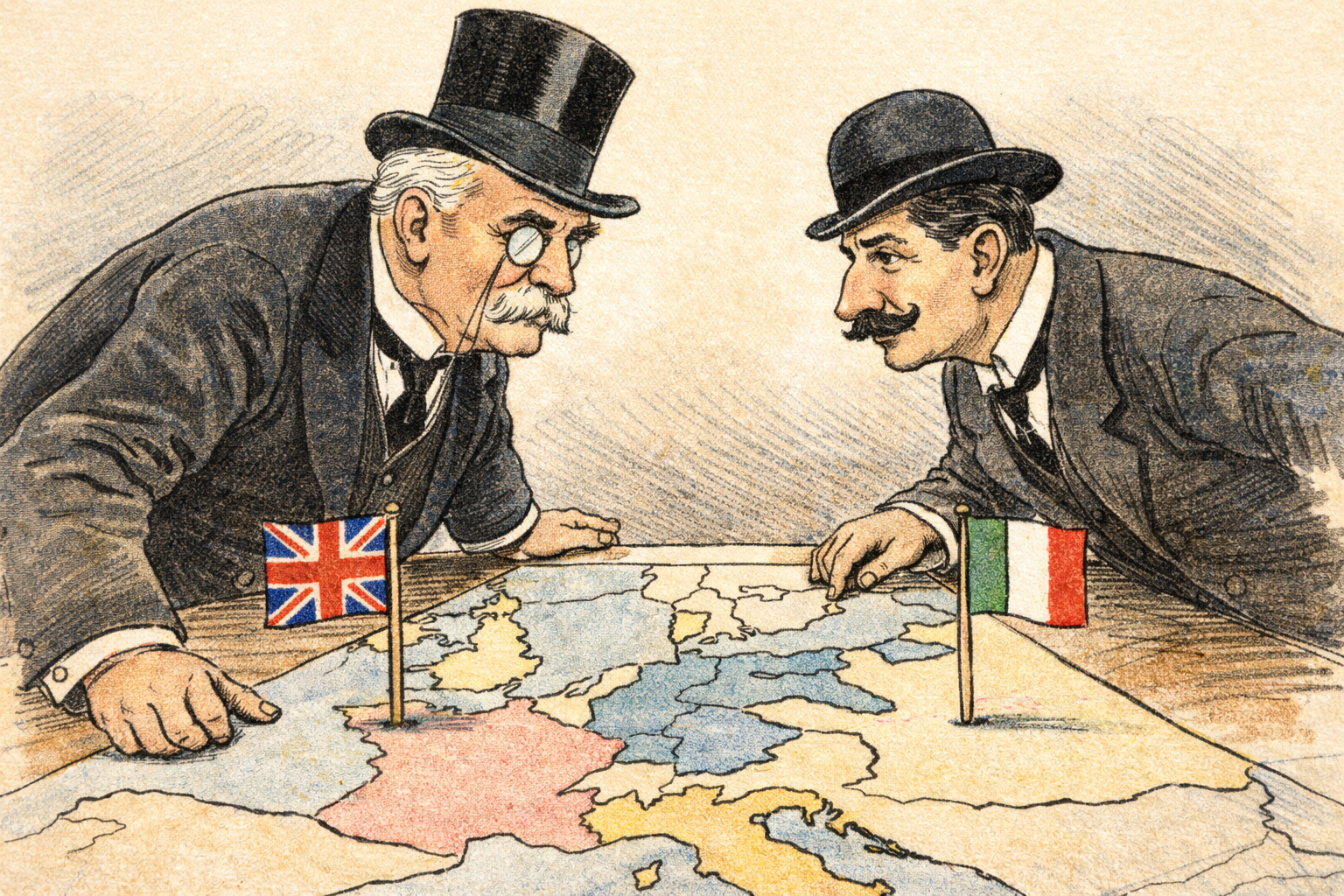
| Powers | England & Italy |
| Game stage | Mid-game |
| Primary target | France; Germany; Russia |
| Alternative names | Anglo-Italian |
This can be an Early Game alliance, but there’s very little that England and Italy can do on their own. This alliance is better as part of a triple alliance at this stage of the game, so I’ll discuss that when I get to the triples – look out for the ‘Guillotine’ and ‘Spaghetti Western’ alliances especially.
Having said that, I was challenged on this, so I’m not saying the E/I can’t work at all in the Early Game. I just don’t see why either power would choose to work together. England’s focus is in the west and north; Italy’s focus is usually in the east and the south, with an occasional push west against France. Even when Italy does push west, though, the two can’t easily cooperate beyond Italy attacking Marseilles and England attacking Brest simultaneously. And France can deal with both of those and still get a build.

I’ve named this alliance the Hadrian after the Roman Emperor who had the famous wall between Roman Britain (England) and Scotland. The aim was to keep the Scots out of England. It wasn’t that successful later in British history, but then again, the fortresses along the wall weren’t maintained.
A Mid-game Alliance
As with the Anglo-Austrian alliance, the Hadrian Alliance is best in the Mid-game as a dual alliance, anyway. At this point, assuming Italy has managed to set itself up in the East, and England has done the same in the West, this Anglo-Italian alliance can work against France or Germany, and – occasionally – Russia.
There is still some difficulty even at this point. As Italy, you still can’t completely afford to ignore your neighbourhood. You’ll have worked together with one, possibly two allies, to reach this stage. This leaves two neighbours looking eagerly at your SCs.
It will also mean a change of direction for Italy. It’s difficult to switch units from the east to the west, although easier to move the focus north. Often, though, France is also still around at this stage of the game; if so, they could well be looking into the Mediterranean waters for further expansion… which means Italy. This, though, is often a good reason for you to look to England for help.
The French Threat
If France has allied with Germany, they’ll have fleets on the board. However, in this case, England is not likely to be in any position to look to work with Italy, although they will be very grateful for any Italian units sailing west!
Let’s assume, then, that France has worked with England. The chances are that France will still be aiming to send fleets into the Med, if they haven’t already. This time, however, England is stronger. There is now a real opportunity to work together: Italy needs English help to survive; England may well be looking to work with Italy to attack France.
This is, essentially, a maritime alliance. Armies will play their part, but it’s difficult for both powers to use their armies. England can get – and may already have – armies on the continent, but they’ll be on the wrong side of France, in the east, possibly the Low Countries, perhaps northern Germany.
For its part, Italy has a narrow land corridor to France, through Piedmont and into Marseilles. Marseilles is easily defensible with a unit in Marseilles and a second in Burgundy.
The soft target is often Iberia. If Italy can get fleets into the Western Mediterranean Sea and/or the Gulf of Lyons, and England gets a fleet into the Mid-Atlantic Ocean, then Iberia is under threat. It can still be difficult, but this is often the way the Hadrian Alliance can find success against France.
The German Option
Generally, as Italy, I’m cautious about heading north. It’s not impossible; if you’ve taken control of Trieste and Vienna away from Austria, you’ve effectively replaced Austria at Germany’s ‘back’. This provides a route into southern Germany through Tyrolia and Bohemia.
This is almost ideal for the Anglo-Italian alliance. England’s units are going to be north of Germany. It’s a good old pincer attack. If England can break into Holland and/or Denmark, they’ll have units a short distance away from Italian armies. However, England will need armies in these spaces: fleets simply don’t reach far enough.
The downside for Italy, and the upside for England, is that Italy only has Munich in reach. Berlin and Kiel, in northern Germany, are much more likely to become English SCs. For Italy, then, the real treasure still comes from France, with the army in Munich providing a second route into France.
The Road to Russia
Russia is another opportunity for the E/I alliance, but a difficult one. If the two powers are in a position to work against Russia, it is a similar option to the Anglo-Turkish alliance.
England’s units will be in the north of Russia: St Petersburg and, possibly, Finland, maybe even Livonia. Italy is more likely to be across Austria. They may have captured all three Austrian SCs. They’ll certainly have Trieste and probably Vienna; Budapest, further south, is less useful for this option, but Italy will probably need the third SC to be strong enough to move against Russia.

Again, then, it is the pincer attack that works, rather than units directly working together. It’s about eroding Russian power in the north and the south to get to the centre.
The View from London
Given that Italy is on the opposite side of any power they can work together against, it’s always about the pincer movement. From this point of view, it’s a less useful alliance than one with a neighbouring power. The only time it would be useful is when you’re aiming to stab a former ally.
The advantage of joint action with Italy is that an attack from Italy will cause the victim to be distracted. The Hadrian Alliance is one of self-interest for England. But there’s nothing wrong with that; Italy will also make gains.
It’s also a safer alliance. When it breaks down, because Italy is on the opposite side of the board, it’s more difficult for Italy to do a lot of damage. And, diplomatically, easier to motivate an Italian neighbour to move against Italy.
The View from Rome
Much of what I said above is the same for Italy, of course. So what’s different?
Well, there’s the maritime threat, especially if working together against France. To be successful, England will have fleets in the west. Those fleets are a latent threat. The chances are, you’ll be on both sides of the Mediterranean, whereas England will have fleets focused on breaking into ‘your’ waters.
Having said that, it might also be an opportunity. You, too, will have fleets in the area, and you’ll be looking to break through into the MAO!


 THE DIPLOMATICON
Leave a comment