

In the first two issues of 34 I’ve examined articles from Richard Egan and Stephen Agar on the state of the Hobby.
Here, I give my assessment of the Hobby today and the future. Does the Hobby still exist? Is there a future for the Diplomacy Hobby?
Questioning the viability of the Hobby is something that many Dippyists have done – and are doing. It’s something we love, in one way or another, and that makes it precious to us. Like most things, when it changes, we’re usually wary of it, worried that it might not be what we wanted it to be.
In the past, the term ‘Hobby’, when it was applied to Diplomacy, meant the postal hobby: zines, games, the people involved. Today, the postal hobby is all-but gone. Why would anyone play by mail when there are email, websites, apps and virtual ways to play? The new ways are quicker and are accessed by a player-base like never before. I sympathise with those members of the Hobby who feel things have been lost. Doug Kent, in an interview for the Diplomacy Games podcast, stated that he missed the community feel of the Hobby as was. I get that. When you’re taking the time to write articles to be published in zines, when you’re travelling across the world to play Diplomacy, there is a unity and togetherness that can’t be matched.
But the postal Hobby is all but gone. There are still postal zines out there. The FTF hobby is still alive and stabbing, although it could need an injection of new players. Today, though, the Hobby means something very different… if, indeed, you still think of it as the Hobby at all.
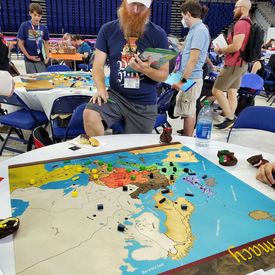
Face-to-Face
In August 2023, World DipCon was held in Thailand. This is the first time it has been held outside of what might be considered a First World, or Western, country (although it has been held in the UK before so give it a few years and this statement may be considered retrospectively inaccurate). There were little more than two dozen entrants, which is a shame. But the fact is that, for many people, travelling to different continents to play Diplomacy is prohibitively expensive.
To be fair, the FTF hobby has been struggling for a while. Covid could well have killed it but, like most things, it didn’t. FTF cons are up and running again; they just need to find a way to get people back and involved.
This, though, is a challenge. Dip conventions are about the tournaments and the community. For new people to get into the FTF hobby, there has to be a way to break into the community and to enjoy the cutthroat nature of tournament play.
Perhaps conventions should feature introductory events, too. Games that are more like house games; not at the expense of the tournaments, but as a way to get people playing Diplomacy in a non-arena atmosphere. This exists with meets organised by groups like the London Diplomacy Club but perhaps pinning these to established conventions is one way to go.
I’m not being critical of hosting WDC in places like Thailand. I think it’s a good idea. What it needs, though, is a legacy being established. Hosting the occasional flagship event isn’t going to be enough – it’s likely to be once a decade, if that – and there’s not going to be much growth in the Hobby in new areas of the world without introducing other formats, too.

Online
The future of the Hobby has to involve playing online in some form or another. The internet has made the world a very small place and it doesn’t matter whether you’re in Thailand or Tennessee, Brisbane or Bridlington (look it up!), playing remotely is the way to grow the Hobby.
The trailblazers for this were the websites. Play-by-email preceded these but PBEM Diplomacy was, originally, the replacement for postal Dip and featured the same people to a major extent. The websites brought new players to the Hobby.
To be fair, though, the websites have pretty much stood still. I’m not sure what more they could do to evolve: you play there, you chat there (where a forum is attached) and you have the chance to join the community on these sites. They’re not, though, making huge in-roads in introducing online players to the FTF hobby. To be fair, that isn’t their purpose; it’s a chance missed, though.
Having said that, the opposite is also true. Read a copy of most zines and you won’t find much mention at all of the online Hobby. This is one of the reasons I’m using 34 and SEND NOOBS1 to focus on the online hobby at least as much as the FTF hobby. It feels as if Extended Deadline Diplomacy is seen as less than FTF Dip. I can remember reading (although I can’t remember where) a renowned FTF player dismissing Extended Deadline play as being “nothing more than playing with a Judge.” Ignorance is damaging the Hobby as a whole.
Nexus Diplomacy, when it launched, boasted that it was the place that would bring the FTF and online arms of the Hobby together. I was sceptical. I’m still not a huge fan of Discord. Running a more traditional forum is much easier than running a Discord server.
What Discord does, though, is bring different server communities together much more easily than site-dedicated forums. And, in fairness, Nexus and similar servers have actually brought players from both arms together much more effectively than I believed it would. And, like a lot to do with Diplomacy, Covid has proved to be a blessing in disguise. Arguably.

Virtual Diplomacy
While Covid was trying to kill face-to-face communities of all kinds, those communities adapted and evolved. Technology to allow people to participate in online conferences flourished and, with it, Virtual Diplomacy was invented (known widely as vFTF – Virtual Face-to-Face Diplomacy).
Tournaments that had been played FTF were moved online and turned into vFTF events. Some of them have even continued that way, even as they’ve resumed FTF events. New Diplomacy arena events were created: the Virtual Diplomacy League is one, and the Virtual World Diplomacy Community2 has become well-established, with its own vFTF world championship. These events are organised principally through Discord servers.
Alongside these came the Diplomacy Broadcast Network. This combines coverage of online, FTF and vFTF arena events, with news across the whole of the Dip Hobby. It even has its own invitational tournament, the DBNI, which has quickly established itself as a flagship tournament. This tournament rates a range of Dip arena events across all formats and therefore brings the various arms of Diplomacy together.
Deadline, the DBN’s news show, has featured interviews and discussions with people from across the Hobby, something which is doing a lot to raise the profile of each format to the whole Hobby community.
Alongside the DBN, and preceding it, are podcasts. The most well-known is the Diplomacy Games podcast. Again, it would be easy for this to focus on one arm of Diplomacy but it doesn’t. Again, it’s an important way for the width and depth of the Hobby to be placed in the consciousness of players across the Hobby.
I’ve not, so far, mentioned the Diplomacy apps. There are two operating currently: ‘Diplicity’ and ‘Conspiracy’. A third app, ‘Primacy’, seems to have dropped off. It is no secret that I’m not a real fan of the apps because they seem to limit gameplay options and rarely is a game to be found there with what I believe is a decent set of deadlines with which to play Diplomacy.
What these apps have done, though, is introduced Diplomacy to the world of mobile games. You can play on Playdip, webDip and Backstabbr on a phone but you’re likely missing something. With the apps, you can see just about everything you could wish to see while playing.
However, the apps do very little to enrich the Hobby in other ways. They have no community and they don’t have any way, on their own, to encourage cross-format participation.

Prognosis: Healthy
Not everyone will agree but I think the Hobby is as healthy now as it has ever been. The number of people involved is greater than ever, due to the online formats. This is perhaps not enhancing the FTF hobby as much as we’d like but it can’t be argued against.
There is no doubt that, for decades, the Diplomacy Hobby was about the postal hobby. That has faded into obscurity. The harsh truth is that it is more convenient to play Diplomacy electronically.
The FTF/PBM community has weakened as a result. It isn’t true, however, to say that there is no community today. There is, and the links between FTF and Extended Deadline communities is stronger today than it’s ever been. I’d like to see more crossover from Extended Deadline to FTF and even vFTF; I’d also like to see some movement the other way. Perhaps more FTF players would appreciate online play more if they stuck it out more.
One of the issues with the online community is that it is splintered. This isn’t surprising given that each community is built around specific sites. When PBEM forums were popular, this was also the case, if to a lesser extent. Part of this is traditional tribalism: my site is much better than yours. There is some movement towards ending this. The Online Diplomacy Championship, that crowns the Extended Deadline world champion, has been hosted by both webDiplomacy and Playdiplomacy. Yet still you have some players stating they’re never going to play on that site. It’s as if they weren’t playing a game called Diplomacy.
The concern I have with the Extended Deadline arm of Diplomacy is that there is an ever-increasing range of arena events to participate in. It may be that we’ve already reached, and even surpassed, the saturation point. A lot of these events are very similar. There are only so many online events that people can participate in at the same time. This is potentially hurting the Extended Deadline community; it makes it seem that there aren’t enough active players to make communities work.
I can also see the same issues with Extended Deadline play as with FTF play, in that new players are easily introduced to Diplomacy but it is becoming increasingly difficult to engage them in the communities. Too many tournaments, when players aren’t ready for them. Some players retreat to playing with a small number of friends in restricted games.
I have to say, too, that I can see a trend towards shorter deadlines in Extended Deadline games. This isn’t preventing people from playing but it is, perhaps, affecting the quality of play. More about that in a different article, though.
On the whole, though, the Hobby is continuing to evolve, albeit in a series of evolutionary leaps rather than smooth development. Virtual Dip has masses of potential. Again, though, it is principally being used for arena events. Wouldn’t it be nice if more friendly, stand alone games were played vFTF?
The only thing that brings continual success in any hobby is if people are intrigued and interested enough in joining it. I don’t think there’s any doubt that Diplomacy has this mass of potential. Occasionally, the game is derided as being decades old. There’s no doubt about that; it’s a game from a different era. But when you discover it for the first time, that doesn’t matter. We need to get people discovering it for the first time.
And this happens every day. Not everyone is intrigued by it, of course, but it is a daily new experience for someone. So it’s about building engagement and encouraging enjoyment. The arena mentality can come later.
NOTES
1. These zines are now discontinued. I’m uploading most articles from 34 on this site. Articles from SEND NOOBS are uploaded on my sister blog Diplopups. I’ll be continuing to write posts for Dip novices on that blog.
2. I would love to provide a link to the VWDC, but my Discord account has, once again, been stopped. It comes down to Discord’s insistence that I have to remove a phone number from an account that doesn’t exist any more. And people wonder why I dislike Discord so much…
First published in 34 #3 in October 2023.
POSTS IN THIS SERIES
- We’re Doomed!
- Still Here!
- Evolve to Survive.


 THE DIPLOMATICON
Leave a comment