
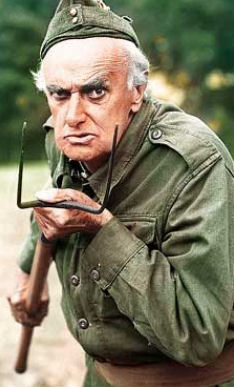
Private Fraser lives and breathes in all of us.
If you live in North America, the chances are you won’t know what I’m talking about. Private Fraser was a character in “Dad’s Army”, a sitcom broadcast in the UK in the late 1960s and throughout most of the 1970s. I watched it as a kid. It was usually broadcast on BBC1 and, if it was a good Saturday evening, preceded “Doctor Who”.
“Dad’s Army” was based on the Home Guard in WWII Britain. These were usually men who hadn’t been conscripted into the British armed services for some reason or other. They were, if you like, the last line of defence: should Nazi Germany invade the UK, these were meant to act as the resistance. In the show, they were represented by pensioners, for the most part, and a motley crew they were, too. One of them was Private Fraser, a Scottish undertaker. National stereotypes being exaggerated, he was dour, anti-establishment in some ways, and he was often heard muttering the phrase: “We’re doomed, I tell ya. Doomed!”
There’s something of the pessimist in all of us, to some extent. In regard to Diplomacy, look at the Carebears. “Well, I’m never going to win a game against six others, so I’m going to play to get a draw.”
And you only have to take part in a conversation with that one person in work who feels everything that can go wrong has gone wrong and will go wrong. Why don’t they get invited to parties?
But, let’s face it, aren’t we all a little like that? “If [insert hated politician’s name] gets elected, I’m moving to [insert name of neighbouring foreign land].” Oh, what a bounty you would be to the natives!
Throughout the history of the Diplomacy Hobby, people have periodically told anyone who’d listen to them that it’s dying. And yet, sixty-five years after Allan B Calhamer started producing his game, Diplomacy’s still around and the Hobby is still around, even if it is probably not in any way something that the Great ABC would recognise and that the early players would have predicted.
But wait: What is the Hobby?

The Diplomacy Hobby
Here’s the key to Egan’s fears: what most of us will think of as being the ‘Hobby’ today was very different then. In fact, in 1990 – and for three decades or so before – the Hobby was PBM (play-by-mail) or Postal Diplomacy (depending which side of the Atlantic you lived).
In 1976 in the UK, the cost of sending a letter first class rose to 10p. Scandalous! Double the price of a tabloid paper such as the Sun or the Daily Mirror. I know; I was there.
If you were playing PBM Diplomacy in the UK at that time, you probably went for second class. Slower (by a day) but slightly cheaper. And it would be delivered at lunchtime (midday-ish) rather than while you were eating your breakfast.
This, though, was how many people played Diplomacy. There were FTF conventions, and, here and there, local groups of Dip players, but the majority of games were played by mail. It was cheaper, it was convenient and it required little modification of the game’s rules.
Games were organised and run through zines. These were produced by enthusiasts of the game. They were sent out by post; you paid a subscription and each zine published a list of people who needed to send some money – through the post, probably a cheque (check if you’re North American), to get the next issue. You sent your orders to the GM (Game Master), the person who was running the game. They would collate orders, adjudicate, and publish the outcome in the next issue of the monthly, bi-monthly or tri-monthly zine. There were complications about Retreats and Adjustments, based on predictions of what each player thought would happen and sending conditional orders for these phases, which (for me) made the game somewhat overly complex. (I admit it – I hated this aspect of PBM play!)
As pedestrian as this may seem today, there was an excitement about this way of playing. It wasn’t FTF play, and for some FTF play was – and is – the highest form of Diplomacy. Not for everyone; Richard Sharp, author of the first – and most influential – book about playing Diplomacy, “The Game of Diplomacy”, stated a number of times that PBM Dip was superior. Players had the time to consider the options and therefore, he asserted, play was of a higher quality without the immediacy of fifteen minute deadlines.
When he’s writing about “the Hobby”, Egan is writing about PBM Diplomacy. He’s thinking of the culture, the community, the method of play, and the history of Postal Dip. Contrast that with what we, in the post-email, automated adjudication age of Diplomacy, consider the Dip Hobby to be (if we think of it as a phenomenon at all).
Egan picked three areas where he felt the Hobby was losing vitality: the number of games being played in his zine “Vienna“; the number of variants being played across UK zines, and the number of zines being published. In all of these cases he saw a decline in numbers.
He also looks at the competition. He was seriously concerned with a phenomenon I never really came across: commercially produced games created deliberately to be played by mail. These, he said, were becoming very successful, and – in contrast – Diplomacy wasn’t really designed for postal play.
And then there was computerisation. When there were programmes to run games, including Diplomacy, why would people want to play Diplomacy by post?
Well, he says, the postal Hobby was cheap. There was also the community itself. It encouraged friendships between people who wouldn’t otherwise ‘meet’. It had led to the organisation of conventions which only added to the social side of the game. So it wasn’t all bad, although he acknowledged that, as people had a greater disposable income, price wasn’t the main positive of the Hobby.
He ended the article by writing:
“Conclusion? When I joined the hobby (aye, lad, them were great days), the talk was all of chat zines and how they were killing it. Instead, the hobby is still breathing a good five or six years later, whilst the chat zines have died and been buried. So I’m not going to be the one who writes it off a second time. But if you ask me, there are lean days ahead…”

So, was he right?
Well, yes he was… to an extent. Five years later, Stephen Agar responded to Egan’s article in Agar’s own zine “Spring Offensive“. Agar titled the article “Why Richard Was Almost Right”. I’ll look at this article in the next post.
If we’re limiting the Hobby to postal Diplomacy, then I think it is very obvious that Egan was absolutely right. I hadn’t heard of a game of postal Diplomacy being played until Simon Langley-Evans launched one in his zine “Last Orders!”. I’ll have to look up how successful it was.
If we leave aside vFTF Diplomacy, as this is a different beast completely, remote Dip – Diplomacy played by people who aren’t ‘together’ – is now played by email, on dedicated websites, or on apps. Yes, there is one for this. Frankly, as soon as the internet and email arrived, it was almost inevitable that this would mean the end for the postal game. The postal game was slow; electronic play is a lot quicker. There isn’t the need to place Retreat and Adjustment orders with Movement orders. If anything, Diplomacy is more suited to electronic play than postal.
The Diplomacy judges were developed, computer programmes that replaced the need for a human GM. Well, they did when the kinks were ironed out. These are also the foundation for the websites and apps. PBEM Diplomacy still uses a human GM but it is the only remote format that does.
The social aspect of the Hobby is still a factor. Conventions and meets are still going strong, although even here the numbers of players are dropping off. And forums and chat groups have replaced the discussions that used to be a huge part of the Hobby through the zines. Of course, zines are still around and every now and then a new one pops up (if you’re reading this, you don’t need me to tell you that!) but the numbers are nothing to what they were even when Egan wrote his article and, of course, he tells us that they’re getting fewer in number. It is very true, though, that players who are happy to discuss every aspect of Diplomacy on forums and chat groups simply aren’t prepared to contribute to zines.
From this point of view, then, the Hobby – the postal Hobby – has all but died out. The Hobby, as Egan knew it, doesn’t exist. In-person play remains, of course, and in the same form, with virtual in-person play added as an extra bonus. Virtual play, of course, is certainly something Egan wouldn’t have recognised.

Was Egan’s pessimism justified?
In context, then probably yes, it was. He saw the decline. We have to remember that the form of the Hobby Egan is considering had been the mainstay of the Diplomacy community for decades. Was there anything else? Well, yes, the start of electronic play. But this was 1990; few people had the skills or finance to participate in this new form. The technology we enjoy today was pretty much a pipedream back then. The term ‘futurist’ wasn’t around then but, if it had been, it would have taken a special visionary to think a board game could be played the way it is today!
Given this, and given Egan’s enthusiasm for the game and the Hobby, it shouldn’t be surprising that he was pessimistic. What he knew and loved was seemingly in decline. Nobody likes wholesale change. People today lament it’s passing. Doug Kent, editor/publisher of “Diplomacy World“, is one such. He will tell you that there is no longer the feeling of community in the Hobby. I disagree but it is certainly a different community.
However, Diplomacy is going strong… and in an ultra-competitive hobby. There are more sophisticatedly designed board games. There are Playstations and XBoxes and Nintendos. There are exciting physical leisure activities. There is a huge range of visual and audio entertainment with which to fill your time. And still people are enthusiastic about this game.
This wasn’t, as it turned out, the end of the Hobby but the beginning of the evolution of the Hobby. If we look at the many ways to play Diplomacy today, and the many ways of sharing our enthusiasm, taking this as the modern version of the Hobby, it is holding its own and going strong.
First published in “34” #1, August 2023.
POSTS IN THIS SERIES
- We’re Doomed!
- Still Here!
- Evolve to Survive


 THE DIPLOMATICON
Leave a reply to Evolve to Survive – THE DIPLOMATICON Cancel reply