
- Power: England
- Group: Northern openings
- When: Fall 1901
- Target SCs: Norway, Denmark, Sweden
- Aggressive towards: Russia
- Extension of: Churchill Opening
This opening is traditionally known as the BOHAS opening and is so-named in the Library of Diplomacy Openings. Honestly, I have no idea what BOHAS stands for, if it stands for anything. It is a family name but, well, I don’t know if anyone called Bohas has been involved in Diplomacy. In the UK, the Bohases lived in Worcestershire (for those of you who don’t live in the UK – and possibly some who do! – that’s ‘Wuhster-shire’, don’t ask me why); there were more Bohases in the US so, I guess, if it was a Bohas for whom it was named, it would be after an American.
But, then, why all capital letters? That indicates an acronym but, well, I can’t for the life of me see where you get the letters from!
Is it geographic? The only place I can find called Bohas is in France, and this opening has nothing at all to do with France so that doesn’t seem to fit.
Now, me not knowing about something isn’t a reason to ditch its name, I suppose, but then again I am naming these openings myself so I guess I can do what I want. And, given my lack of any reasoning as to where this name came from, I’ve decided to use an alternative name from Toby Harris’ article “England for Experts”, published in The Diplomatic Pouch F2015A issue. Here, Harris called this the ‘Paul Levy Opening’ so I’ve just shortened it to the Levy Opening.
By the way, before we actually look at this extension opening, if anyone does know why this was called the BOHAS Opening, please enlighten me.

What is the Levy Opening?
The Levy Opening follows on from the Churchill Opening…
- S1901: F Edi-NWG, F Lon-NTH, A Lpl-Edi
- F1901: F NWG C Edi-Nwy. F NTH-SKA
Here, then, England starts with the Churchill Opening. From there, they convoy the army to Norway via the Norwegian Sea and move F NTH-SKA.
This is, ostensibly, worked in alliance with Germany. Germany bounces Russia in Sweden, which is something that Germany will be considering anyway, and England moves to Skagerrak. The skill to this opening, though, is in the off-the-board work.
Effectively, this works off a 3- or 4-way, anti-Russian alliance. Primarily, England is forming an Anglo-German alliance, working initially against Russia, with France on the back-burner (but not too far back).
However, the key to the success of the Levy Opening comes from the secondary alliance in the East. Here, Austria and Turkey are persuaded to prevent Russia from gaining Rumania, preventing any Russian build. Why? Because the Levy Opening aims to take both Sweden and St Petersburg.
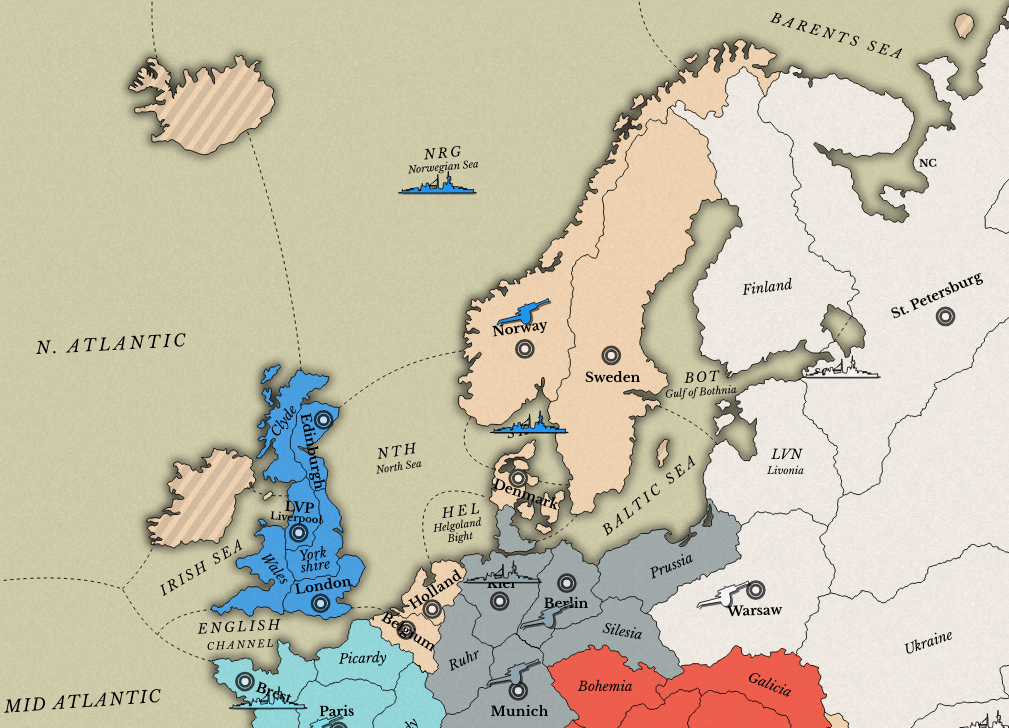
Just to be clear, here’s what the position looks like in W01:

From this position, England is able to force their way into Sweden. The W01 build is a fleet that supports Germany into Belgium, the pay-off for getting Sweden, and the Norwegian Sea fleet, moving to the Barents Sea in S02, is able to support A Nwy-Stp in F02.
Here’s what the position might look like after F02:
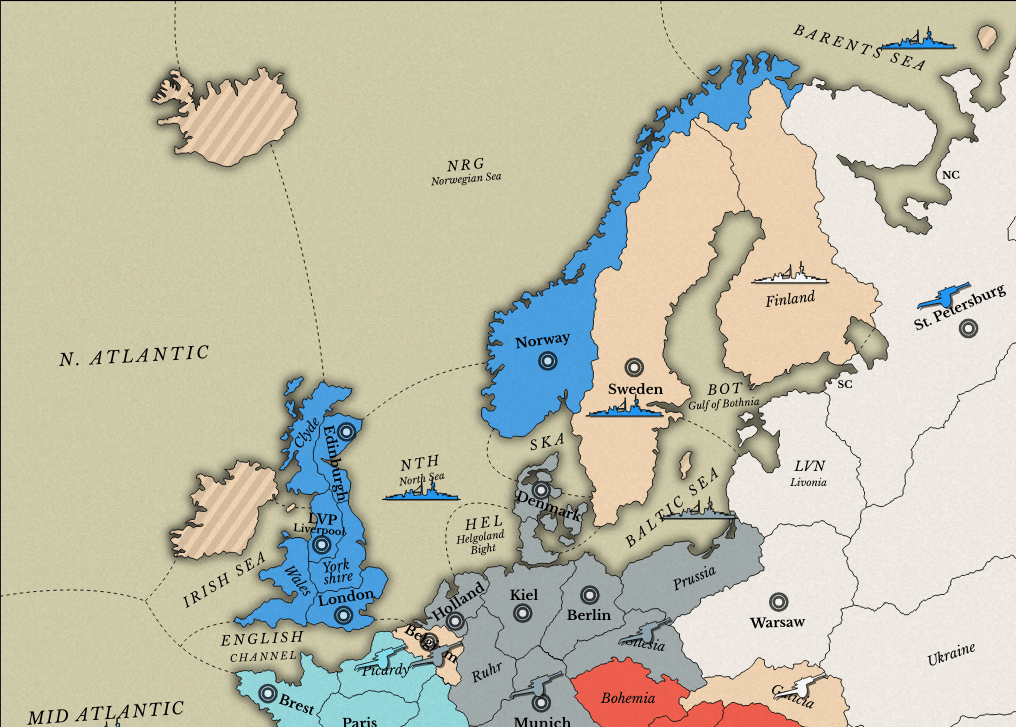
Russia, for all intents and purposes, is close to being beaten already. I’m not showing what’s happening in the south, of course, because this is England’s openings. And I’ve not shown what France may be doing (they probably have a fleet in the Irish Sea of the English Channel at this point, given that they must have realised that there’s an E/G alliance by now!).
Given my penchant for fleets, my two builds are fleets in London and Liverpool. If Germany builds an army in Berlin, it can be convoyed to Livonia and Russia may well have lost Warsaw and Moscow by the end of 1903. E/G are also in a strong position to attack France.

Skagerrak
Skagerrak (yes, that’s how it’s spelt) is, perhaps, an underrated space. Just look at it, for England, offensively. It’s a square with Norway on top, Sweden on the right, Denmark at the bottom and the North Sea to the left. Three SCs. The only real disappointment, from an attacking point of view, is that you can’t move directly to the Baltic Sea.
I call this area of the board the Skåne Axis. Skåne is the southern-most county in Sweden, on the Swedish side of the Øresund Bridge linking Denmark and Sweden. If England manages to cross this axis, they’re on for a win.
With the Levy Opening, of course, this isn’t England’s aim. And if Germany builds a second fleet in W01, aiming to get to the Baltic Sea as described above, then England is going to have to wait to cross it… if they need to! However, with an English fleet in Sweden, Germany already has to deal with England bang on the axis.
From Skagerrak, though, England has options. Three SCs under threat. Support to gain Sweden. The option, if things go differently, to make a move on Denmark. Defence of Norway. Support to get a fleet into the North Sea.
The downside of F NTH-SKA is that it leaves the North Sea open, and that’s not ideal in most circumstances. With the Levy Opening, then, you need to be confident of having Germany onside. The one problem is getting Germany to give you Sweden, an SC most Germans would see as being ‘their’ SC. Are they prepared to take Belgium in return?
Speed over Security
The brilliance of the Levy Opening is that it gives England a speedy growth. This is why Harris likes it. If you read his articles in The Diplomatic Pouch, from the Fall 2015 Movement Issue, starting with “Austria for Experts”, to the Spring 2017 Movement Issue with “Turkey for Experts” (“Italy for Experts” was a 2-parter and TDP didn’t publish an F2016A issue), you’ll see he’s not a fan of cautious play.
This is especially so with “England for Experts”. He certainly prefers an aggressive approach, certainly in the Early Game. “Just remember one thing … 18 centres rarely comes [sic] to those who ‘wait and see’,” he says. What is the “wait and see” approach to playing England? “The neutral approach with Russia tends to be along the lines of putting a fleet into Norway in exchange for no Russian builds in Stp.“
For me, I don’t mind playing England cautiously. I think it’s one power that you can afford to do this with. However, Harris is writing from the point of view of tournament play (most of the time) and the aim is to establish a strong, survival position early on, giving you the chance to push this further as the game progresses. In a standard game of Dip there isn’t as much need to push to a strong position early.
One downside of establishing an early strength for England is that it can tip other players over the wrong side of the relationship. The Levy Opening is best when you can persuade the Eastern powers to prevent Russia from building. You really need to stop Russia getting an extra unit in St Petersburg in W01. And, from there, you are reliant, although less so, on them not changing this anti-Russian approach, which they may do when they see the E/G alliance getting the level of success this opening can give them.
However, the key to success in Diplomacy is having an alliance that is not reined-in by cautious play. You and your ally should be prepared to take risks. With the Levy Opening, England is risking it all on an alliance with Germany. This shouldn’t be too difficult: Germany is making gains. But Germany will want Sweden, as I’ve alluded to above. They should be prepared to let you take it by Germany gaining Belgium instead, as well as the strength of the E/G alliance, but it’s a possible stumbling block.
England is also risking an aggressive France, so you’ll need to be able to keep France neutral initially. It won’t take long for France to see what’s really going on but you can’t afford to let them get into a threatening position. That comes down, as always, to your diplomacy.
Germany also faces risks. Look again at the position after F02 above. Denmark is open, and England has fleets in Sweden and the North Sea.
What’s happening is that England and Germany have decided that they need to trust each other and go for it. This is when you’re going to do well in Diplomacy. It’s more common in the FTF game than online, and this isn’t surprising. FTF (and vFTF, although less so) is a smaller playerbase. The chances are that you’re going to know more about the players. And there’s no anonymity. Online, the chances are you won’t know much about the players you’re up against, and anonymity is common. It’s more difficult to trust someone you don’t know.
It’s a shame that alliances in the online game tend to be governed by caution. However, you should have more time to persuade your ally of your trustworthiness, too. Go for it!
POSTS IN THIS SERIES (Links marked with [X] indicate extensions to the initial openings.)
- England’s Opening Moves – Introduction
- Churchill Opening
- Jorvik Opening
- Leith Opening
- Ouse Opening
- Severn Opening
- Grampian Opening
- Pennine Opening
- Snowdonia Opening
- Western Opening
- Yorkshire Pudding Opening
- The Levy Opening [X]
- The Arkangel Opening [X]
- The Norwegian Gambit [X]


 THE DIPLOMATICON
Leave a reply to England’s Opening Moves – Introduction – THE DIPLOMATICON Cancel reply