
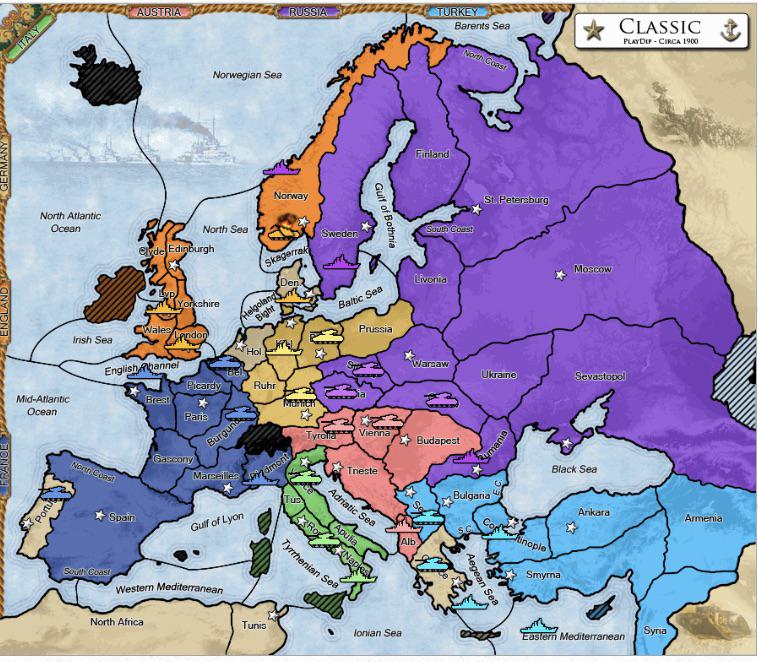
As I’m writing this I’m part way through rebooting this blog. One of the reasons I chose to do this is that I wanted to re-write the posts I’d produced on opening moves in a game of Diplomacy.
Why do this? Because I’ve changed my opinion about what’s important about opening moves… yes, again!
I’ve deleted what I’d produced before on this subject because it didn’t really reflect what I wanted to say. Sorry for those of you who’ve commented on those posts; maybe you can comment on the new ones coming out?
The Thing to Remember
Opening moves are the moves made in Spring 1901. The first moves you make in a game. As such, there’s no harm in the practice of naming these moves. Why not? It gives those of us who spend our time writing about them something to label moves by.
Opening moves might also mean looking at what happens after S01. If you want, you can call these ‘extension’ or ‘continuation’ openings. These might also be named.
But what’s important about the opening you choose is that it moves you closer to your initial objectives. If you’re France, and you want to capture Belgium in 1901, you don’t move F Bre-MAO, A Par-Gas, A Mar-Spa. That isn’t getting you anywhere near your objective. On the other hand, if you want to show that you’re neutral towards both Germany and England, and that you’re fully onboard with a Western Triple alliance, then these might be the moves you make.
If you’re Russia, and you want to make a big impression in the south, you might open with F Sev-BLA, A War-Ukr, A Mos-Sev, F Stp(sc)-GOB. Three units in the south is a good way to go. It isn’t going to help with attacking Germany, however.
Your opening moves, then, should be supporting the decisions you’ve made away from the board. They shouldn’t be the moves that you’ve been told, or that you’ve read, are the ‘best’ for the power you’re controlling. What’s best for the power you’re controlling depends on what you’ve decided to do off the board.
Diplomacy is Everything
So let’s take a step back before we finalise our orders, before we say we’re ready to move on.
At the start of S01, and indeed at the start of every turn (if you’re playing online), it makes sense to enter some orders. These may very well be the ones you’re planning to make, or the ones you think you should be making for your power. But don’t finalise them just yet!
On many – but by no means all sites (Diplicity doesn’t allow this) – Spring 1901 is a longer deadline. In the rules it’s suggested that Spring 1901 should be twice the length (thirty minutes) of every other Diplomatic Phase. This gives you ample time to message other players.
Well, it should do. It depends on the deadline lengths of the game you’ve entered. Remember, though, that this is a game where the really important stuff takes place away from the board… doesn’t it?
You should be giving yourself enough time, in selecting the deadlines or in choosing a game to play in, that gives you the time you’ll need to message the other players. To negotiate with them. To persuade them to work with you. To persuade them that you’re not the enemy. Enough time, in short, for diplomacy.
I know, I know: we’re all eager to play, aren’t we? We all want to see things happening on the board. That’s the exciting bit, isn’t it? It’s the bit we see covered by DBN and by other commentators.
Well, there’s a reason this is the main area of coverage: for commentators it’s the only thing they’re party to, the only part of the game they take part in. They don’t hear or read the negotiations.
And it’s the bit that decides who is doing well, who is doing badly, and who is making progress towards winning the game.
But everything else is what leads to what happens on the board. The actual movement of units is the result of what has gone on behind the scenes. It is away from the board that the game is really played.
So, at the start of the phase, by all means enter some orders. If disaster strikes and – for whatever reason – you miss the deadline, at least your units will be doing something. It may not be what you wanted, but it’s better than an NMR.
But use the time to diplomatise. (I wish that was a real word.) And your diplomatising (it really should be a real word!) should lead you to enter the orders you will actually use.
A Different Approach
There is an alternative approach to this way of playing, though. I favour what I’ve described above because that’s the way I like to play. I’m nothing if not flexible.
The other way is to decide what you want to do and then use the Diplomatic Phase to get other players on board with you. I admit to using this method myself, occasionally.
Even so, take a step back. Enter your preferred orders, as you should, but – again – don’t finalise.
With this approach, rather than testing the water, deciding which player will be the best with which to ally, you’re trying to persuade others that they should go with you.
You might be England, for example, and you’ve decided that you really want to move F Lon-ENG in S01. There are certainly advantages to doing this: France is, strategically (and leaving all other considerations aside), the best power to attack first as England, for a number of reasons (that I’m not going into here).
In S01, then, you’ll be working on persuading France to let you move to the Channel… or persuading them that you’re not moving there, depending on whether you’re definitely thinking of going with an anti-French alliance with Germany (and, preferably, Italy).
You’ll also need to use the time to persuade Germany that you’ll be a better ally than France will be. And you’ll want to persuade Italy that, despite the many options and concerns that Italy has (most of which you have no influence over on the board), they really ought to be joining you and Germany in attacking France.
But what if you feel you’re not achieving a measure of success at this? What if, after all, those orders you want to use aren’t necessarily the right ones? What then?
Well, clearly, you should change them. Do you feel France is going to order F Bre-ENG? Then you shouldn’t be ordering F Lon-ENG… there are better things it can be doing than bouncing in the English Channel!
Are you unsure about the efficacy of an alliance with Germany? Do you think Germany might not be quite as sold on the Anglo-Saxon alliance as you’d like? Is the player controlling Germany a dick? Perhaps, then, alliance with Germany isn’t the best thing…
The board should reflect your diplomacy
Whatever happens, in S01 and in any other Diplomatic Phase, whatever orders you enter, they should reflect what you want to happen.
This means that any discussion about opening moves needs to be tempered by what you actually want to achieve.
Let’s stick with the example of England, as that’s where I’ll start the series. If you’re attacking France, F Lon-ENG is a key move, so the chances are you’ll choose a Southern opening (or, perhaps, but less effectively, a Splits opening).
If you’re wanting to make sure of an SC, the only option in 1901 is Norway, and this will probably mean a Northern opening. You may even have decided to take St Petersburg from Russia, which might mean looking to order F Edi-NWG and then on to the Barents Sea.
If you’re planning on attacking Germany first, then you want to stay out of the Channel, and avoid anything that might break the trust you’re trying to build with France. In that case, the only option for F(Lon) is F Lon-NTH and a Northern opening.
If you’re unsure, then perhaps F Lon-ENG is still the move you want to make… but not if you think it will bounce France. If you’re convinced that France is likely to order F Bre-ENG, then let them; A Lpl-Yor will let you cover the possibility of an F01 order of F ENG-Lon from France. (A Yor-Lon).
Whatever your opening moves, they should reflect what you think is going to happen. And you can’t meet this criterion if you’re ordering because you think you should do this simply because you’ve read it or heard it.
The ‘Opening Moves’ Series
What follows, then, is a discussion on opening moves that doesn’t reflect what the ‘best’ moves are strategically, for the most part. Instead, it focuses on the objective(s) you’re aiming to achieve, and the diplomacy that has gone on off the board.
I will name the openings (because why not?) but I will discuss these in terms of what objectives you’re seeking. I will be naming these openings, as a point of reference only.
It will be broken down into a series of openings for each power, with an introduction for each power that lists the openings.
One final thing, I won’t necessarily be using the names you’ll find in the Library of Diplomacy Openings (although it will reference these). Partly, this is because these names can be pretty confusing: there are numerous ‘Yorkshire’ openings for England, for instance. Partly, this is because the series reflects my ideas and, as such, I can call them what I like!
I hope you enjoy it!

 THE DIPLOMATICON
Leave a comment