
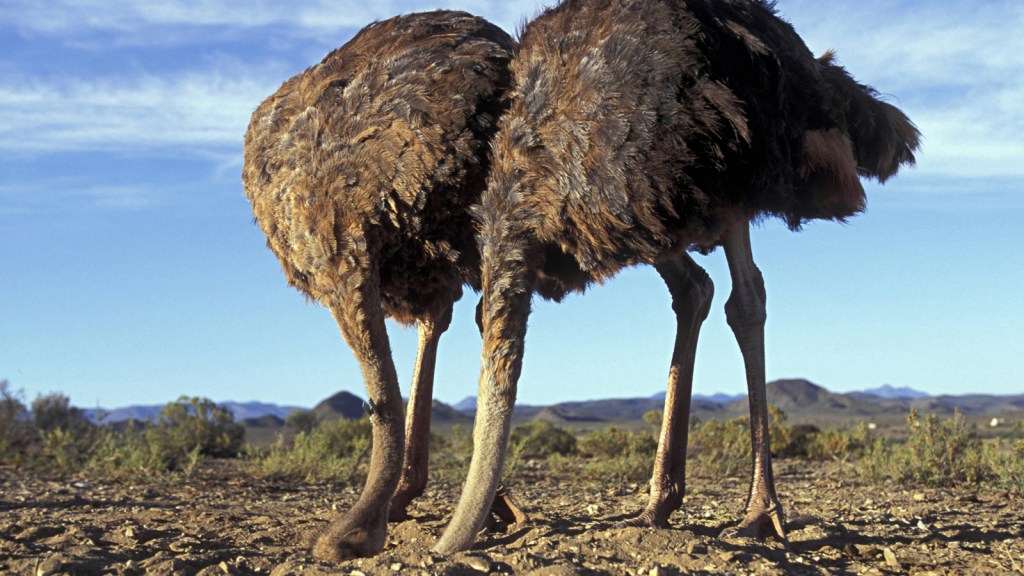
The largest bird on the planet, and how does an ostrich defend itself? By burying it’s head in the sand, apparently.
Well, this is something of a myth. To avoid danger, an ostrich will lower itself to the ground and make itself as flat as possible. The chances are, if an ostrich appears to have its head in the sand, its probably turning the eggs in its nest.
But, honestly, I like the idea of burying heads into the sand. If you don’t take any notice of the danger, perhaps it will go away?
Ostriches are, of course, the largest bird on the planet. They live in Africa, in two areas, and two diverse species. They originated in Asia, however, and migrated to Africa. They’re fast, too, running at about 70 km/h (43 mph) so they can outrun most danger. But why put yourself to that much energy?
The Diplomacy ‘Ostrich’
A Diplomacy ‘Ostrich’ takes the view – or lack of a view – that, if they ignore the danger they’re in, it will go away. Yes, they bury their head in the sand.
You may have heard of the ‘Armoured Duck’. This is a player who sticks to one track of action, no matter what. Richard Sharp (I believe) named this player in his book The Game of Diplomacy.1
The Ostrich isn’t quite as dedicated as the Armoured Duck. However, they do tend to ignore warnings that what they’re doing is putting themselves in danger.
Ostriches, then, are difficult to persuade of any consequences of their actions. They don’t necessarily get themselves stuck on one track, but they make themselves wilfully blind to what might happen if they don’t change what they’re doing.
If you can send an Ostrich running towards somebody else’s SCs, you’ll probably be able to take advantage of them doing so.
- “The Game of Diplomacy.” Ch.2 “The smyler and the knyf under the cloak.” Sharp, R. Arthur Barker, 25 Jan 1979. Accessed 16 June 2025. ↩︎

 THE DIPLOMATICON
Leave a comment