
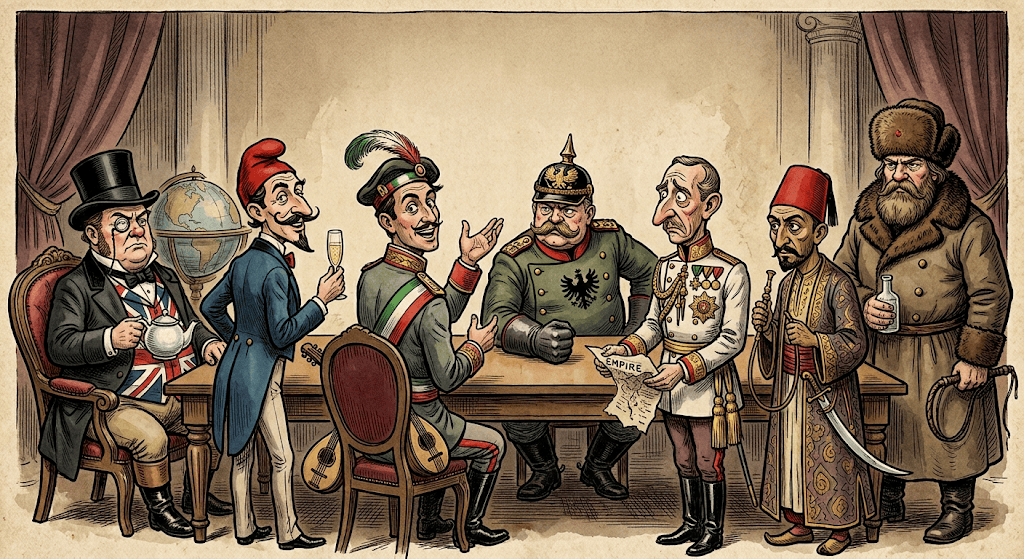
I have decided to write a series of posts that are an in depth look at the seven powers in Diplomacy.
Now this isn’t something new. It’s been done before, and I’ve produced posts like this before. But this time the idea is to look at each power over a number of posts in much more depth than usual.
Why have I decided to do this? Well, for two main reasons.
First, it’s been a long time since I’ve shown any love for this blog. I wanted to get it going again, and this is a subject that is a nice way to start. It’s comfortable and, frankly, players – especially new players – tend not to recognise that each power needs to be played differently.
And, secondly, as I’m writing a book about everything Diplomacy (borrowing a title from an Allan B Calhamer article, “Across the Whole Board”), I thought I’d do some writing about the powers here that will be reflected in the book. So, something of a guineapig run, I suppose.
The Format
There’ll be a subseries for each power: Austria-Hungary, England, France, Germany, Italy, Russia and Turkey. Easier to keep things going that way. I haven’t decided, yet, whether I am going to write each subseries in full, or if I will look at each section of the subseries in turn. Whatever floats my boat at the time, I guess.
Each subseries will focus on the following topics:
- Position on the board: How geographical layout of the map affects the power and the choices you have.
- Strategic overview: An introduction to what each power should be looking to achieve, other than the obvious!
- Alliances: The general impact your choice of ally will have on the way you approach the game. This will be split into 2-way and 3-way alliances.
- Early game strategy: What the aims of each power might be at the beginning of the game and how to achieve these.
- Opening moves: The moves in 1901 that might are realistic options and why you should choose each one.
- Mid-game strategy: What to look for should be reach the mid-game.
- Endgame strategy: How to bring the game home for each power.
In General …
But first, I wanted to put some thoughts down about how I’ll be approaching this series, as a way of setting context.
One thing to remember, and this is important, is that you should never take what anyone tells you about playing Diplomacy as a panacea to your ailments when playing the game. There are no hard and fast rules to playing Diplomacy. That way leads to disaster.

You bring your own ideas to each game and each power. And each game is unique: you’ll never play the same game twice. Even if you play a game in which you face exactly the same seven players, controlling exactly the same seven powers, it will play out differently, if only because each player will have learned lessons from the previous game!
There are, of course, some things you probably shouldn’t do. As Italy, you probably shouldn’t try to fight on two fronts at the start of the game. You need to focus on one route because, otherwise, you’re likely to end up the meat in a salami sandwich.
Don’t, however, take anything as ultimately unchallengeable advice.
ALLIANCES
As I’ve said previously, alliances are between players, not powers. When I’m writing about alliances, I’m going to be discussing the merits of allying with the power(s) in question. But this is a guide to what you might want to achieve by choosing that alliance.
When it comes down to who to ally with, this is a complex choice based on a combination of strategy and personality. I’m not going into this more here – follow the link above if you want to know more about my thoughts on this.
OPENING STRATEGY AND OPENING MOVES
I’m looking separately at opening strategies and opening moves.
Opening strategy is very much more than a discussion on the moves you might make. Strategy is about choosing a way forward that will get you through the Early Game. It is about how form your objectives and how to achieve them.
Opening moves will be more of a discussion about what each move brings about. How do these moves help you to successfully achieve the objectives of your opening strategy?
MID-GAME AND ENDGAME STRATEGY
When discussing strategy in the later stages of the game, there are two many variables to discuss things with any degree of certainty. You’ll find, therefore, that these sections are very vague in terms of what you should be doing and how you should be doing them.
These sections would be very similar if I did them for each power, so I’ve decided to write them as single articles for all of the powers.
The Context
It’s also worth explaining the context in which I am writing these guides. In general, I write them as if you’re playing to win the game.
Surely, this doesn’t need to be said, does it? I think it does.
There are players out there who don’t see winning as the ultimate objective. I’m not talking about settling for a draw when the solo is out of the question. Everyone has to reach this conclusion at some point in some game! That’s the way most games will go, unless you’re playing with a complete board of Diplopups.
I’m also not talking about the situation you may well come across in an arena game of Diplomacy, a game that is part of a tournament or league. In this form of play, you’re likely to not be setting out to solo, simply because there may not be the time to achieve this. In an arena game, the chances are that winning is defined as finishing the game with the most SCs owned… which might, in some circumstances, equate to soloing, but is not necessarily the way the game will play out.
I’m talking about players who see the aim as being to create and maintain a game-long alliance, and to draw the game. This approach to playing, ‘Carebearism’, is a perversion of the games objectives. I’m not saying it should be illegal, but I am saying it isn’t what the game is about.
So, if you’re a Carebear, some of what I say isn’t going to applicable to you. That doesn’t mean there’s nothing in the articles you can’t take from them, just that this isn’t context in which I am writing.
AUSTRIA-HUNGARY
ENGLAND
FRANCE
GERMANY
ITALY
RUSSIA
TURKEY
ALL
Mid-Game Strategy
Endgame Strategy


Leave a Reply