
Austria-Hungary can be one of the most difficult powers to play in Diplomacy. Drawing this power often produces a sigh of resignation from players.
It doesn’t have to be that Austria’s many neighbours gang-up on you, however. As long as you’re prepared to put the time and effort into playing Diplomacy as a diplomat, you can actually do pretty well with the power.
Understanding the geography of the board, however, is very important for playing Austria well. This article aims to help with that.
An Inner Power
There are two types of power on the board, based on the geography of the board: Inner Powers and Outer Powers. Austria is very clearly an inner power, very much centrally placed.
Inner powers need a lot of work. Austria has three immediate neighbours – Germany, Italy and Russia – and, just the other side of the Balkans, Turkey also qualifies as a neighbour. This means a lot of potential enemies or, if you prefer – and you should prefer! – allies.
This means that Austria needs to commit to a lot of communication. It is very easy for Russia and Turkey, two outer powers, to form an anti-Austrian alliance. In fact, if they can persuade Italy to join in, this triple alliance – that I call the ‘Viennese Sandwich’ alliance – can be devastating.
Austria also needs to be in communication with France, especially if you’re thinking of attacking Italy. A friendly French fleet or two sailing into the Mediterranean in the Early Game is a great way for Austria to find success if attacking Italy.
England… well not so much work here. England is too remote. This doesn’t mean you don’t need to talk to England, however. Communication is the key to good Diplomacy play, and at some point – hopefully – you’ll need to find a way to work with England. Better to have started the process early.
In the East
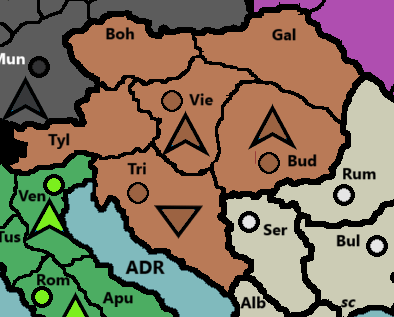
Austria is firmly placed in the eastern side of the board. If you draw a line from North Africa, in the south-west, to St Petersburg, in the north-east, you split the board into two. 17 SCs on either side of the board. Austria has two non-SC spaces in this line: Tyrolia, to the north of Trieste (in Austria) and Venice (Italy), and Bohemia, to the north of Vienna (Austria) and east of Munich (Germany). This means that Austria actually sits on this ‘Barren Zone’ of spaces.
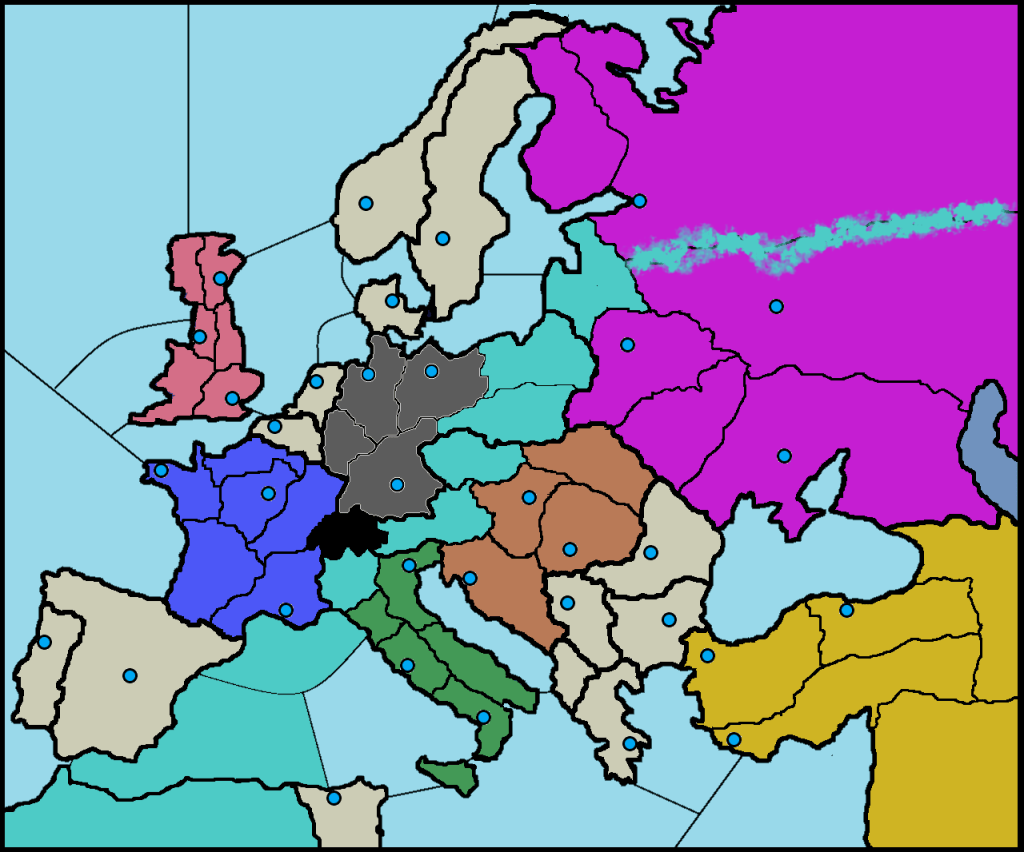
This means that it is easier for Austria to cross the zone, although not all that easy. To head north-east, towards Germany, isn’t something Austria would want to do in the Early Game too often, as Germany is often a good cartel ally (an ally you don’t necessarily work with but one who will leave you alone). Later in the game, Austria is likely to need to cross into Germany to gain a win, however.
Austria’s focus, then, is to the east and south. South-east of Austria are five neutral countries: Rumania (bordering Budapest in Austria and Sevastopol in Russia), Serbia (bordering both Budapest and Trieste in Austria), Albania (south of Trieste and a non-SC), Greece (south of Albania and Serbia, and stuck out into the Mediterranean), and Bulgaria (bordering Constantinople in Turkey).
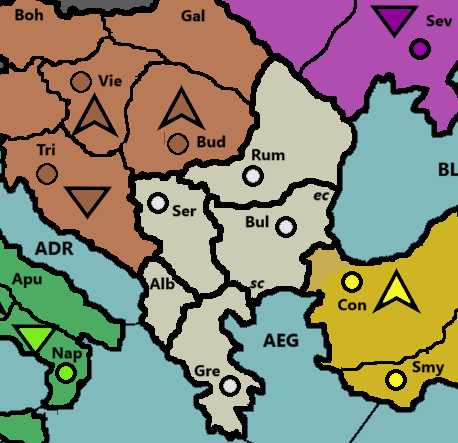
This is where Austria needs to be thinking of expanding. Rumania and Serbia can be taken in Spring 1901, although Russia will want dibs on the former. Greece can be reached in Fall 1901, with the Austrian fleet (based in Trieste) travelling through Albania in S01.
The Italian Problem
You should also note on thing of high importance: on the border between Austria and Italy are two SCs. This is a unique situation: nowhere else on the board do two powers have neighbouring SCs.
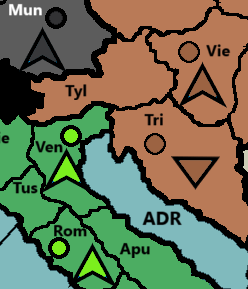
When the game starts, Austria has a fleet in Trieste, while Italy has an army in Venice. Either could happily occupy the other’s SC in S01. Often, however, this isn’t the case. If the two players are cautious of each other, they might agree a ‘bounce’ in S01, in which Austria orders F Tri-Ven, and Italy orders A Ven-Tri. This provides some security for both players, although it isn’t ideal, certainly for Austria as it all-but means Greece, often an Austrian target in 1901, is out of reach.
More common, should Italy seek to attack Austria, is an Italian opening along the lines of A Ven-Tyl (Tyrolia, north of Venice) and A Rom-Ven. This puts two armies bordering the vulnerable Trieste, and A(Tyl) also borders Vienna. This means that, along with the insecurity of having an Italian army starting right next to Trieste, Tyrolia is also an extremely important space for you to think about.
An Angry Bear?
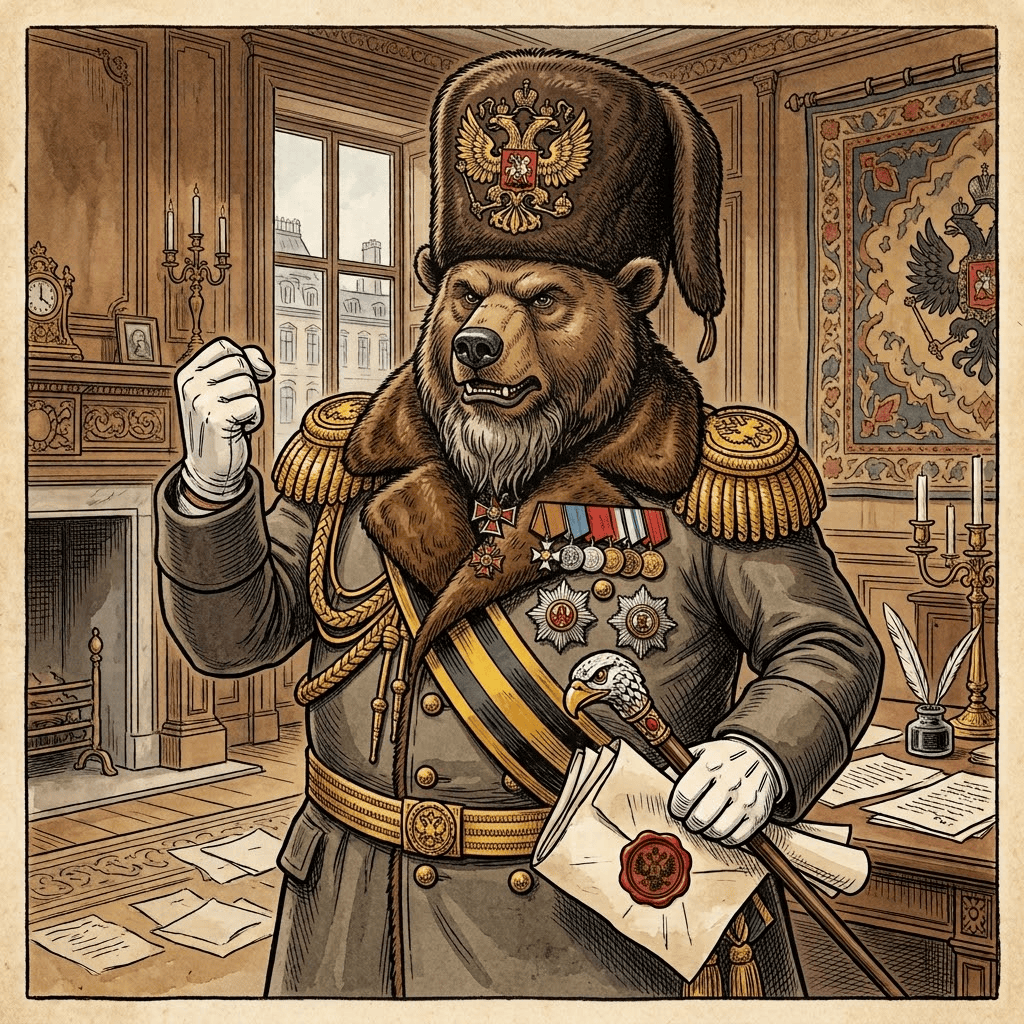
Russia is also problematic. They don’t threaten one of your SCs immediately, but they can cause you major problems simply with one order: A War-Gal.
Galicia is an Austrian non-SC to the north of Vienna and Budapest, Austria’s two landlocked SCs. It also borders Warsaw, a Russian landlocked SC to Galicia’s north. Should Russia successfully occupy Galicia in S01, you face the threat of an attack on either Vienna or Budapest… and this is a very likely threat.
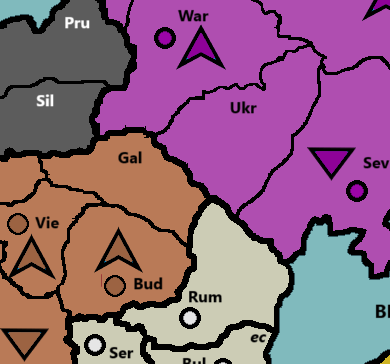
Thankfully, Russia can’t move an army into Rumania from the start; the unit in Sevastopol – Russia’s southern-most SC bordering the Black Sea – is a fleet. However, if A War-Gal is accompanied by either A Mos-Ukr or A Mos-Sev, Russia has two or three units bordering Rumania. A Russia who does occupy Galicia in S01 will likely be telling you they’re heading for Rumania, even if they’ve ordered F Sev-Rum and already occupy it! If they’ve got A(Gal) and A(Urk/Sev), don’t believe them!
Galicia, then, is another of your home spaces you need to be concerned about.
The Bounty of the Balkans
Every Balkan SC can be reached by Austria in 1901, although the chances of occupying any of them is not the same.

Serbia is immediately south of Budapest. It is common for Austria to occupy and own Serbia in 1901, with a close to 100% certainty rate of owning it.
Greece can be captured in F01 and becomes more likely if Austria orders F Tri-Alb and A Bud-Ser. This places two units on the borders of Greece. However, Italy may well have ordered F Nap-ION, bordering Greece, and it would be a shocking outcome if Turkey hasn’t ordered A Con-Bul, also bordering Greece. At this stage, a combination of I/T aiming to prevent you from capturing Greece is small: Italy runs the risk of not gaining a single SC in 1901 if they don’t use their fleet to capture Tunis (either by occupying Tunis, to the eastern end of Africa, or by convoying an army there). While Turkey might well try A Bul-Gre in F01, this is more in hope of preventing an Austrian occupation than in taking it. Austrian chances of taking Greece, then, are better than 50%.
Rumania is less likely. If you open with A Bud-Rum in S01, you have approximately a 50% chance of success, given that Russia could just as easily open with F Sev-Rum or F Sev-BLA. Assuming you don’t bounce in Rumania, though, what are the chances of holding it? Poor. Russia is likely to have two units bordering the space, with the fleet (wherever it is) and an army in Ukraine, Sevastopol or Galicia. While one of these units could be distracted, or prevented from supporting the other, Russia may also have a third army bordering Rumania. The chances of taking Rumania in 1901, then, are about 25%.
Bulgaria is highly likely to be Turkish at the end of 1901. They can move there immediately, as mentioned above. They can also have a unit bordering Bulgaria: either a fleet in the Black Sea or Constantinople, or their second army in Constantinople. While it’s possible for Russia and Austria to combine to take Bulgaria off Turkey in F01, it’s unusual. Bulgaria? Possibly approximately 5% likely.
However, with the right alliances, Austria can be looking to take three of the Balkan SCs for their own in the Early Game. This is often by targeting Turkey, and either an A/I alliance or an A/R alliance can be successful in doing this. For either such, Austria has a good chance of taking Bulgaria as the attack on Turkey succeeds.
Rumania is also a possibility. Should Turkey side with you against Russia, while Rumania can become Turkish following a successful attack on Russia, it is common for this ownership to switch as Turkey captures Sevastopol.
The Balkans, then, are often the springboard to Austrian growth. But to do this, Austria needs a strong alliance… and it could be with any of the other three eastern powers.
Turkish Delight?
Turkey, separated from Austria by the Balkans, is still a neighbour. Given that they border Russia, they’re a good choice of ally if you’re aiming to attack Russia.
Turkey is also a good choice if you can persuade them to build fleets while you concentrate on armies. Given that two of your SCs are landlocked, Turkish fleets offer no threat.
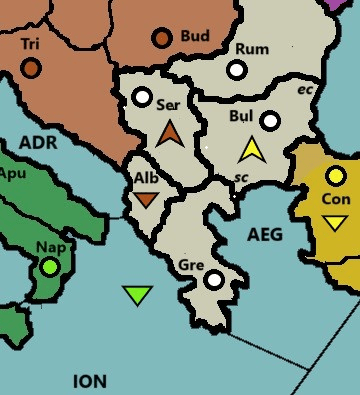
However, Austria and Turkey both have greedy desires towards Greece. Given that Austria can have two units bordering Greece in F01, and Turkey just one, Austria is more likely to capture the SC. But it isn’t 1901 we’re concerned with, it’s later in the game. Turkish fleets, so good for Austrian homeland security, can easily become a threat to Greece.
The Backstop
Germany should be easy to deal with. Their focus is often to the north, occasionally with a stray thought to the east. Germany isn’t a threat most of the time.
In fact, the Austro-German alliance is probably one that you can rely on. The two of you don’t need the worry of an attack from the other. You are focused in opposite areas of the board. This is an ideal arrangement: “You go your way, I’ll go mine, and we’ll watch each other’s backs.”
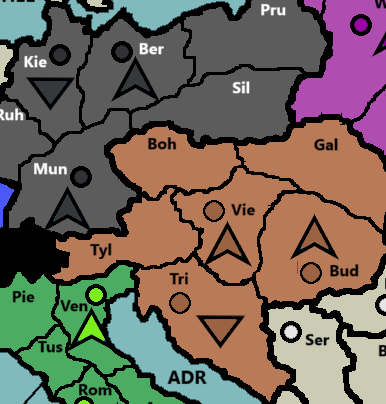
This alliance, which I call the ‘Duel Alliance’ because this was the name given to it in WWI (it is commonly known as the ‘Anschluss’ but that’s a WWII name so I avoid it in favour of the more contemporary name) is often more binding on Germany. If Russia attacks Galicia, Germany often has the option of bouncing Russia from Sweden, while warning Russia against aggression towards their ally.
Later in the game, though, Austria will often have to attack Germany in order to get across the Barren Zone.
Defending the Seas
Austria is unique in that they rarely carry a maritime threat. Look again at Austria’s geography:
Only one space has a sea border, Trieste, which is where Austria’s fleet starts (where else?). Compare that with your neighbours: Italy is a peninsula and every space is a coastal space; Turkey, while not exactly a peninsula, is almost the same; Russia has four coastal spaces, although only Sevastopol is in the east; Germany has three coastal spaces, comfortably away from the Mediterranean.
The Med sea spaces are Austria’s worry. Easily accessible to Italy, Turkey and France (although the latter needs to find a way past Italy), Austria is often left reliant on these Mediterranean maritime powers reaching a stalemate. Should one gain the upper hand then all the spaces Austria is looking to expand into, except Serbia, are under threat.
Austria itself is under limited threat from the sea; that one coastal space might be limiting offensively but it is a strength defensively! However, you’ll need to be considering a how to frustrate Italy and Turkey in their attempts to gain control of the eastern end of the Med.
Fleet builds, for Austria, may come along later in the game, but initially the focus has to be on armies.
THE SEVEN DIPLOMATS: INTRODUCTION
AUSTRIA-HUNGARY


Leave a comment