

In July 2015 the Association for Computational Linguistics (ACL) published a research paper called “Linguistic Harbingers of Betrayal: A Case Study on an Online Strategy Game” and, surprise surprise, that game was Diplomacy.
It makes for interesting reading, although Dippyists with some experience would probably say that the findings are fairly intuitive. And, let’s face it, any research paper that manages to get the word ‘harbinger’ into a title is worth a read anyway!
I thought, though, that I’d write about the paper and its findings. It would probably make sense for you to read the paper first!
I wanted to start with an introduction to what the paper was researching. It’s probably pretty clear from the title that it’s looking at what clues there are in a person’s language that indicate betrayal.
If this paper is accurate, it can be of great use to you as a Dip player. Not only would it help to anticipate an impending stab, it could also be used to mask one! Imagine that! Not only are you planning to stab your erstwhile ally but you’re going to successfully hide that fact from them! Invulnerability, here I come!
Well, unless of course your opponent has read the paper, too, and they’re applying the lessons from it, in which case you won’t see their stab coming. Dammit.

Definitions
Let’s start by looking at some definitions for words and terms that come up in the paper.
- “… we explore linguistic cues that presage such transitions by studying dyadic interactions.” Dyadic simply means ‘two persons” so they’re looking at messages between two people. Similarly, the word dyad is used throughout, by which they mean a 2-player conversation.
- Stable friendships: These are when two players have shown evidence of “at least two consecutive and reciprocated acts of friendships that span at least three seasons in game time. We also check that no more than five seasons pass between two acts of friendships, as friendships can fade.” This is based on on-the-board actions. Of course, two players could be allied without any on the board action at all but this is difficult to evidence accurately.
- Betrayals: “Betrayals are established and reciprocal friendships that end with at least two hostile acts. The person initiating the first of these hostile acts is the betrayer, while the other person is the victim.”
These two definitions are important for the research they’re doing, which is aimed at comparing the language used by and messages exchanged between two ‘friends’ and those between two friends who become ‘enemies’.
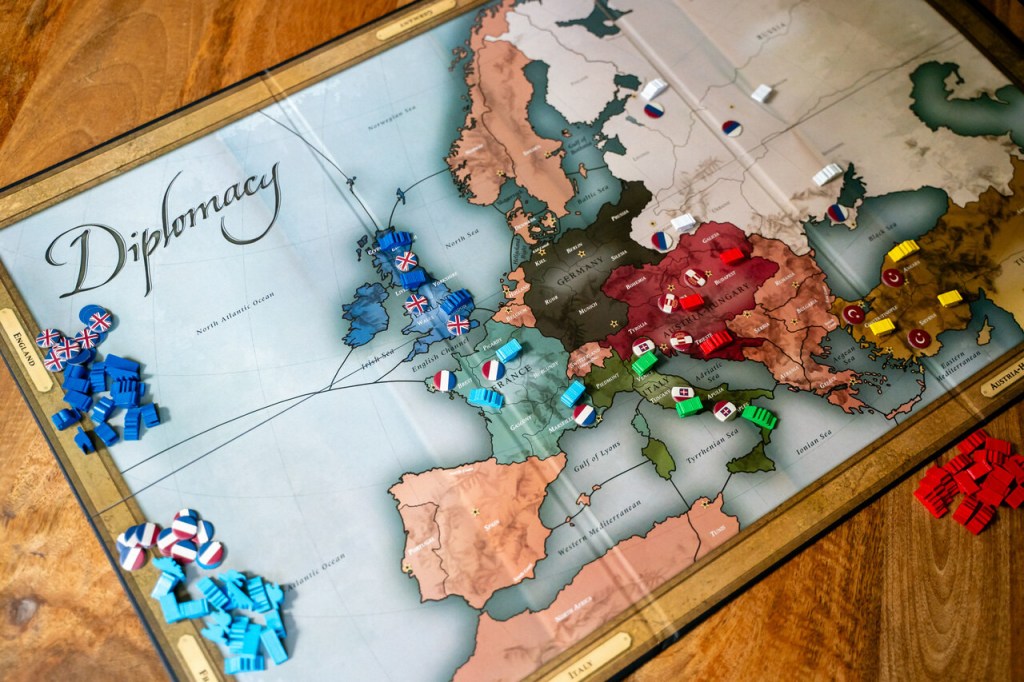
Their description of Diplomacy
If they’re using Diplomacy as the basis of their research, it follows that they must explain the game. Unfortunately, there are some errors in how they describe it that a picky Dippyist – me – could find a little irritating.
First, they don’t accurately describe the objective of the game: “The goal of the game … is to capture all of the territories on the game board.” Of course, it isn’t: the goal is to control the majority of supply centres on the board.
In case you’re new here, and you’re unsure of the difference between the words ‘capture’ and ‘control’ here it is. You can capture an SC by moving into the space the SC occupies. However, if you do this in a Spring turn, you won’t own or control that SC; you are simply occupying the space. Your unit needs to remain in occupation until after the Fall Retreats phase. Only then do you own or control the SC.
Second, they don’t accurately describe how the game is structured: “Each season consists of two alternating phases: diplomacy—the players communicate to form strategies—and orders—the players submit their moves for the season.”
In traditional rules, the game is split into years (1901, 1902, etc), turns (or seasons if you like) (Spring and Fall), and phases (Moves, Retreats and, in the Fall turn, Adjustments). The modern rules go further, dividing the phases into Diplomacy, Orders, Resolution (I’d prefer ‘Adjudication’ but meh), Retreats and, in Fall, Adjustments. What they’ve done is split the main phase – Moves – into three. This makes sense although it’s quite likely that players will write their orders throughout the Diplomacy phase.
It’s a small error and an understandable one – the authors aren’t interested in the Resolution, Retreats or Adjustment phases because there’s no communication in these phases under the game rules (although there is likely to be when played online).
Third, they over-simplify some of the explanations about the game: “Instead of moving, a unit can
support another unit; large armies can be created through intricate networks of support. The side
with the largest army wins the battle.”
This is being very picky, I know, but it ignores the action of fleets. The majority of SCs on the board are accessible to fleets: there are 34 SCs and 27 of them are ‘coastal’ SCs. Oh, well.
They seem to have their timings wrong: “We use games from two popular online platforms for playing Diplomacy. The average season of an online Diplomacy game lasts nine days.” This was before the current preference for shorter deadlines but, even so, turns online rarely last that long… unless they were concentrating on games with long enough deadlines to allow more complex communication.
These differences don’t affect the outcome of the research, though, and I only mention them because, well, they’re acknowledged inaccuracies among Dip players. Some of this is about simplifying the terminology or explanation of the rules so that they don’t hamper the reason for the article in the first place.
So, let’s move on to the findings.
POSTS IN THIS SERIES:
- Harbingers of Betrayal: Introduction
- Harbingers of Betrayal: Findings
- Harbingers of Betrayal: Lessons


 THE DIPLOMATICON
Leave a comment